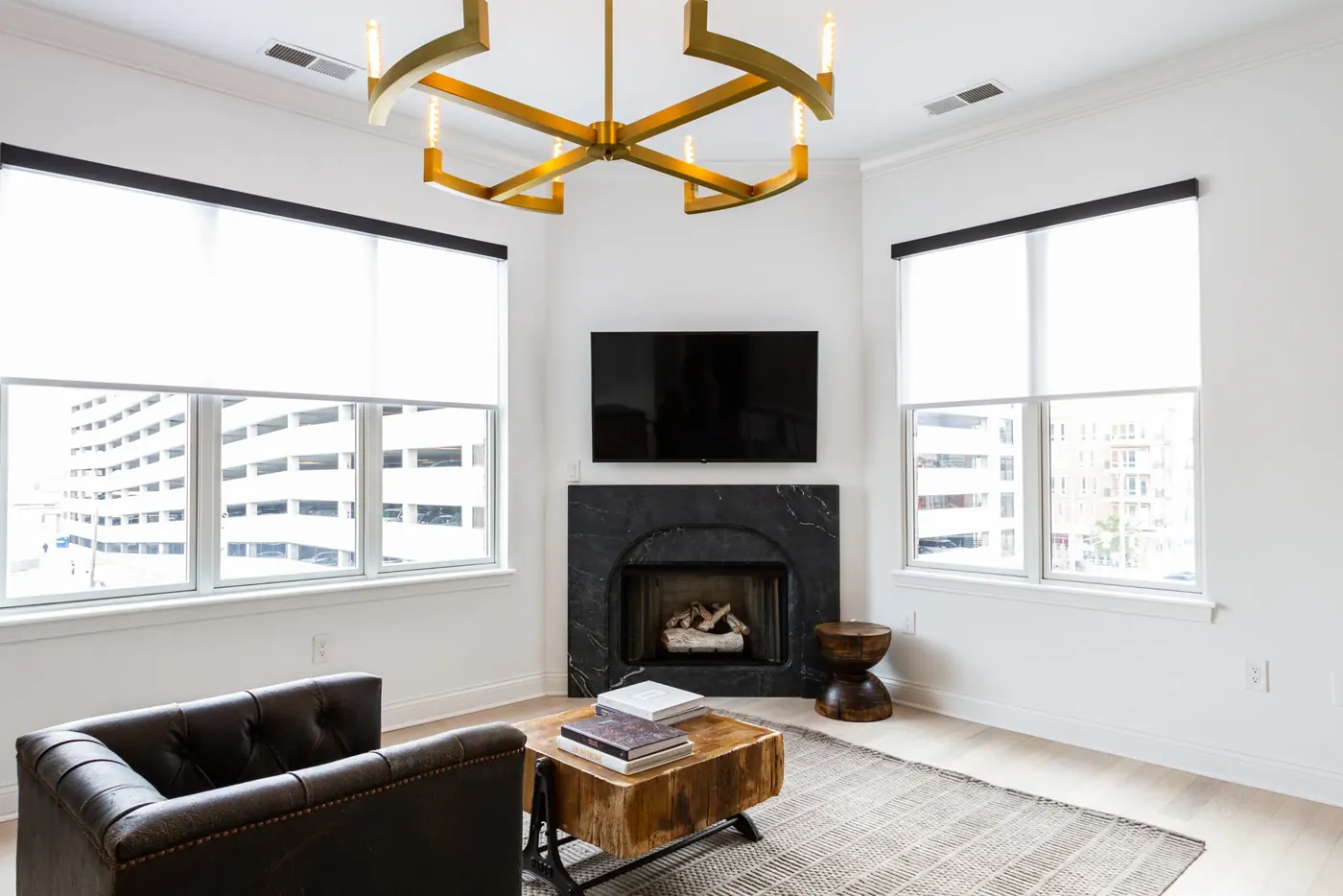
Butler-Tarkington Window Treatment, Indianapolis, IN
Custom Indianapolis window treatment crews serving Butler-Tarkington homeowners with free in-home measure, repair, replacement.
If you live in this area of Indianapolis, some of these answers will sound familiar. Older openings, shallower depth and out-of-square conditions come up regularly and none of them are a problem once they're measured.
- Services: faux wood blinds, wood blinds, vertical blinds, aluminum mini blinds
- Service area: Butler-Tarkington, Indianapolis, IN and surrounding areas Getting somebody out to measure is the easy part and happens on a normal schedule. After that the fabricator needs roughly two to five weeks. We give you a specific window when we write the order.
- Insured and bonded
- Serving Indianapolis, IN since 2008
Local Window Treatment Experience in Butler-Tarkington
The setback is the fastest way to tell which job you have. A streetcar bungalow on Illinois, Capitol or Boulevard Place sits close to the sidewalk with little foreground planting, so its front rooms take direct low angle sun and direct pedestrian sightlines in a way the deep set Meridian houses never do. That's a privacy problem and a glare problem arriving through the same opening, and the products that solve both are not the products you'd put on a mansion. Counts run 12 to 18 on a bungalow, 18 to 26 on a house near the Butler campus, and 30 to 45 on a Meridian Street mansion.</p><p style="font-size:16px;color:#4a5a6a;line-height:1.75;margin:16px 0 0">The neighborhood came together in two waves. Indianapolis annexed upper Meridian Street between 38th and 50th Streets across 1899 to 1909, which spurred ten separate housing developments. Then Butler University relocated to Fairview Park in 1928 and created a substantial area of desirable home sites, driving the second wave. Underneath all of it was Mapleton, a German farming village of the 1840s. Roughly fifty years of residential building sits on top of that, which is why the stock reads as consistent in age and wildly inconsistent in scale.
We have served Butler-Tarkington homeowners through the full range of window treatment needs, from inspections and repairs to full replacements. Whatever the system, our Indianapolis crew approaches every project with clear communication and respect for your property.
920 acres, ten developments and two completely different populations
The bungalow belt and the Meridian corridor share a neighborhood name and very little else. Bungalow lots are small and narrow, the houses stand close to the street where the streetcar line ran, and the elevations are one and a half stories with banded groupings under broad eaves. The Meridian corridor carries two and three story interwar period revival on mansion grounds. Between them, around the Butler campus, the sourced description is that the houses reflect the Meridian Street mansions on a decidedly smaller scale, which is a fair account of what you actually see: the same architectural repertoire, reduced.
No single production builder worked here. Ten separate housing developments followed the annexation, and the result is a neighborhood that reads as coherent from a car and varies house by house on foot. Median household income is $90,000 against a citywide $66,219, and 66 percent of residents hold at least a bachelor's degree against a citywide 34.9 percent. Butler University and Hinkle Fieldhouse anchor the north end, Christian Theological Seminary sits alongside, and Holcomb Gardens runs down to the Central Canal towpath on the western edge.
Shallow setbacks, deep grounds and one neighborhood name
The bungalow belt gives you banded groupings under broad eaves, front dormers and a wide opening facing the porch. Those banded groups look best under one continuous headrail rather than three separate products, and getting that right means a single finished width with the mullion positions confirmed on site. The Meridian corridor gives you the full period revival range: leaded multi light units, some of them inward opening, Palladian and arched stair windows, fanlights, sidelights, bays and oriels. Masonry reveals on those houses add depth that the bungalows don't have. Around the campus the same shapes appear at reduced scale, so the vocabulary is familiar and the dimensions aren't.
The shallow setback is the physical fact that most changes what we specify. A bungalow standing close to the street has less planting between the glass and the pavement, so more direct low angle sun reaches the front elevation and more of the room is visible from the sidewalk. On Meridian, deeper grounds and mature planting soften both. Along the western edge the Central Canal means canal facing lots back onto open water with no neighbor behind. The residential stock is 85 to 126 years old, so three point measure applies throughout.
Banded groups need one headrail
Three openings under a single broad eave on a bungalow read as one architectural element, and three separate blinds break it up. We measure the group as one finished width with the mullion positions confirmed in place, then specify a continuous headrail with the tilt operating across the whole run. It costs a little more to fabricate and it's the difference between a bungalow front that looks designed and one that looks retrofitted.
Street close means top down
Where the house stands close to the sidewalk, a shade lowered from the top gives you privacy at eye level while daylight still comes over it. That's the specific answer to the specific problem the streetcar belt has, and it's why top down bottom up gets specified here more than anywhere else on the north side. We'll show you the stack the top rail creates at the head, because it's visible and people are surprised by it.
Inward opening units on Meridian
Leaded multi light units on the interwar mansions frequently open into the room, which means an inside mounted product would sit in the operating arc. We identify those openings during the measure and specify an outside mount clear of the swing, generally on a header board fixed to solid framing. The leaded work is worth keeping visible anyway, and an outside mount lets the whole opening show when the treatment is up.
No certificate, on either half
Butler-Tarkington isn't in the IHPC layer, so there's no certificate of appropriateness requirement anywhere in it, including on the Meridian Street mansions and inside the Butler-Fairview and Butler University areas recorded in the city's historic sites inventory. Exterior awnings and exterior shades are open to you. We check for a recorded covenant on your own title before quoting, because none was identified but we don't assume.
What we specify most in Butler-Tarkington
No neighborhood specific median sale price was published for Butler-Tarkington when we last looked, so we won't put a number on the housing here. What we can say is that a 12 to 18 opening bungalow and a 30 to 45 opening Meridian mansion are separated by more than three times the count, and that the mansions carry a higher share of specialty shapes that price and schedule above the standard lines. National ranges put custom shades at roughly $250 to $2,600 a window, drapery $300 to $4,000 and motorized product $300 to $1,500 installed.
Cellular Shades
Specified here mainly as top down bottom up, which is the right answer for a bungalow standing close to the sidewalk. You get privacy at eye level and daylight over the top, without the room going dark at three in the afternoon. Cellular also carries the winter argument: DOE and Oak Ridge testing measured up to 20 percent of heating energy saved against a bare window, which matters in a one and a half story house with a lot of exposed wall.
Woven Wood Shades
Bungalow interiors were built around wood, and a woven natural shade sits with that better than a flat modern fabric does. The weave passes light by design, which suits a front room that needs softening rather than darkening. Where you also need a dark bedroom we add a separate liner instead of pretending the weave will handle it. Every panel varies slightly, which is inherent to the material and worth knowing before you order.
Wood Blinds
Around the Butler campus, houses that echo the Meridian mansions at reduced scale have real wood casing and rooms that hold their conditions year round, which is exactly where hardwood slats belong. The tilt gives you control over low angle sun without committing to covered or uncovered. We keep hardwood out of bathrooms and unconditioned porches, because the humidity swing across the muggy season moves wood every year, in both directions.
Custom Drapery
On Meridian between 40th and Westfield, ceiling heights and window proportions were designed for fabric and nothing else reads correctly at that scale. Hung high on a traverse rod with a proper return and deep pleats, drapery also solves the light leak at the sides that an outside mounted shade leaves on a tall opening. Yardage and fullness drive the budget more than the fabric price does, so we settle those before anybody picks a color.
Getting around Butler-Tarkington
The neighborhood runs between the Central Canal, Meridian Street, 38th Street and Michigan Road. Meridian-Kessler lies immediately east across Meridian Street, Golden Hill immediately southwest across the canal, and Crows Nest to the north. Butler University and Hinkle Fieldhouse are the fixed points, with Holcomb Gardens running down to the canal towpath and Christian Theological Seminary alongside. Schools split by address between Indianapolis Public Schools and MSD Washington Township, which means Shortridge for some addresses and North Central for others. The Indianapolis Museum of Art at Newfields sits just beyond the southern edge.
One of the oldest associations in the country, and no authority at all
The Butler-Tarkington Neighborhood Association was established in 1956 to conserve and improve the neighborhood, and it's recognized as one of the oldest continuously operating neighborhood associations in the nation. It's voluntary. It holds no architectural control over your property and it isn't a mandatory homeowners association. There's no IHPC district here either, so no certificate of appropriateness applies to exterior work anywhere in the 920 acres, on a bungalow off Boulevard Place or on a mansion between 40th Street and Westfield Boulevard. No recorded covenant governing window coverings was identified. If you hold deed restrictions from one of the ten original developments, those would be the only enforceable limit, so it's worth a look at your own title before ordering anything that fixes to the outside of the building.
Window Treatment Services in Butler-Tarkington
Every service Indianapolis Window Treatments offers across Indianapolis is available to Butler-Tarkington homeowners.
Faux Wood Blinds in Butler-Tarkington
Wood look, in the rooms wood can't survive
Learn more →Wood Blinds in Butler-Tarkington
For conditioned rooms where the trim is the point
Learn more →Vertical Blinds in Butler-Tarkington
Built for the opening you walk through
Learn more →Aluminum Mini Blinds in Butler-Tarkington
Low cost per opening, specified to be reordered
Learn more →Roller Shades in Butler-Tarkington
One clean plane, and nothing crossing the glass
Learn more →Solar Shades in Butler-Tarkington
Cut the glare, keep the view, pick the number
Learn more →Cellular Shades in Butler-Tarkington
The one product with measured energy data behind it
Learn more →Zebra Shades in Butler-Tarkington
View by day, cover by night, one motion
Learn more →Roman Shades in Butler-Tarkington
Soft treatment for rooms with height to fill
Learn more →Woven Wood Shades in Butler-Tarkington
Natural texture, with the liner question answered first
Learn more →Blackout Shades in Butler-Tarkington
Dark rooms are hardware, not fabric
Learn more →Plantation Shutters in Butler-Tarkington
The frame absorbs what the opening has done
Learn more →Cafe Shutters in Butler-Tarkington
Privacy at eye level, daylight above it
Learn more →Motorized Shades in Butler-Tarkington
Reachable is the reason. Batteries are the cost
Learn more →Custom Drapery in Butler-Tarkington
Yardage sets the price. The fixing decides the outcome
Learn more →Valances & Top Treatments in Butler-Tarkington
The line that makes mismatched windows read as one
Learn more →Exterior Solar Shades in Butler-Tarkington
Stop the heat outside the glass, with the district checked
Learn more →Retractable Awnings in Butler-Tarkington
Shade in July, sun in January, certificate first
Learn more →Commercial Window Treatments in Butler-Tarkington
Code, cycle count and phasing decide this, not fabric
Learn more →Skylight Shades in Butler-Tarkington
Overhead glass, planned from the ground up
Learn more →Sliding Glass Door Blinds in Butler-Tarkington
The stack has to land off the panel you use
Learn more →Panel Track Blinds in Butler-Tarkington
Stack depth and stack side decide this one
Learn more →Sheer Shades in Butler-Tarkington
Diffused light for windows worth looking at
Learn more →Pleated Shades in Butler-Tarkington
Shallowest headrail in the trade, honestly priced
Learn more →Bamboo Shades in Butler-Tarkington
Natural weave, with the liner question answered first
Learn more →Dual Shades in Butler-Tarkington
Two fabrics, one tube, level or nothing
Learn more →Top-Down Bottom-Up Shades in Butler-Tarkington
Daylight above, cover at eye level
Learn more →Cordless Blinds in Butler-Tarkington
No cords, and a spring that's a wear part
Learn more →Hardwood Shutters in Butler-Tarkington
Real wood, in rooms that stay conditioned
Learn more →Composite Shutters in Butler-Tarkington
For damp rooms, with the weight planned for
Learn more →Smart Home Shade Integration in Butler-Tarkington
Protocol first, range second, hub risk disclosed
Learn more →Blind Repair & Restring in Butler-Tarkington
We check the headrail before quoting the labor
Learn more →Shutter Repair in Butler-Tarkington
Matchable or not, established before we schedule
Learn more →Motorization Retrofit in Butler-Tarkington
Not every headrail takes a motor. We check first
Learn more →Outdoor Patio Shades in Butler-Tarkington
Wind decides this. Anchor into structure, not trim
Learn more →Office Window Treatments in Butler-Tarkington
Control height and openness factor, then fabric
Learn more →Healthcare Window Treatments in Butler-Tarkington
Test documentation, cordless throughout, cleanable surface
Learn more →Multifamily Window Treatments in Butler-Tarkington
One written spec per floor plan, dye lots disclosed
Learn more →Our Working Area Around Indianapolis
Butler-Tarkington is one of several Indianapolis communities we serve. We measure and install across Indianapolis, Marion County, and surrounding areas.
Butler-Tarkington Window Treatment FAQ
Questions we hear most often from Butler-Tarkington homeowners.
Free Assessment in Butler-Tarkington
Schedule a free, no-obligation window covering inspection. We respond promptly to all Butler-Tarkington inquiries.