Vertical Blinds in Indianapolis, IN With Indianapolis Window Treatments
Built for the opening you walk through
Read these before you choose a fabric. Material, mount and lift decisions constrain what fabrics make sense, and working in that order avoids falling for something that won't work in the room.
- Service: Vertical Blinds for Indianapolis homeowners
- Service area: Indianapolis, IN and surrounding areas It depends what's broken. Hardware repairs on existing blinds and shades usually come together quickly. Replacing an entire custom product means starting the fabrication clock again, which is two to five weeks in most cases.
- Insured and bonded
- Serving Indianapolis, IN since 2008
Expert Vertical Blinds for Indianapolis Homes
Verticals exist for one opening, and Indianapolis has an enormous number of them. 174,653 housing units in this city went up between 1940 and 1979, and the sliding patio door is what a very large share of them put on the back of the house. That opening defeats horizontal product. It's too wide for a single headrail to hold level, it gets walked through several times a day, and a raised horizontal blind sits in the traffic.
A vertical track handles it because the vanes stack to one side and clear the door leaf. That's the whole argument, and it's a good one. Track width sets the price rather than the number of vanes, so a wide opening is one unit rather than three, and the stack can be set left, right or split to the center depending on which leaf actually slides and which way the room is used.
The failure mode is worth stating before you buy. Vanes warp, curl and stick in their carriers, particularly vinyl vanes on a south or west elevation where they take heat all afternoon. Fabric and faux wood vanes behave better. Individual vanes are replaceable without redoing the track, which is one of the few genuinely cheap repairs in this trade, and it's the reason we keep vane availability in mind when specifying a line.
Signs You Need Vertical Blinds
If you notice any of these in your Indianapolis home, it is worth booking a measure. None of it is urgent, and none of it fixes itself either.
The patio door has nothing on it and the room has no privacy
Existing vanes have warped, curled or fallen out of their carriers
A horizontal blind on the door has to be raised every time
Vanes catch and stick when you pull the chain
The opening is too wide for a single horizontal headrail
A commercial space has a long run of floor to ceiling glass
The stack sits over the leaf you actually use
Sun through the patio door makes the room unusable by afternoon
How Indianapolis Window Treatments Handles Vertical Blinds
Every job follows the same six-step process. Transparent, thorough, and done right the first time.
Establish which leaf slides
Before measuring we work out which door leaf actually opens and which direction the room flows. That decides stack side, and getting it wrong is the most common complaint on this product: a stack parked over the leaf you use every day is an irritation forever. Split stacks are available where a wide opening is used from both ends, at the cost of a seam in the middle.
Measure the full opening
A patio door is measured as one opening rather than as a door plus a sidelight, because the track has to run the full width for the vanes to stack clear. We take three widths and three heights, check the diagonal, and confirm what the head condition is: whether there's a header to mount to, how much depth exists above the door, and whether there's any obstruction in the way.
Choose the vane material
Vinyl is the base and it's the material most likely to warp on a hot elevation. Fabric vanes hang better and soften the room. Faux wood vanes read closest to a shutter and weigh the most, which matters over a long run. On a south or west patio door in Indianapolis we'll push toward fabric or faux wood, because a vinyl vane on that exposure is the one that curls.
Plan the headrail and control
We set the mounting height so the vanes clear the floor without dragging, decide whether the track runs inside the opening or above it on the header, and pick the control. A wand is the simplest and safest. Where a continuous cord loop is specified, a chain tensioner is fitted at install because an untensioned loop is a safety failure rather than an aesthetic one.
Order with spare vanes
On any track over about eight feet we recommend ordering a small number of spare vanes with the job and keeping them. Vanes are the wear item, they're the cheapest possible repair, and matching them from the same production run three years later is the part that goes wrong. It's a small line on the order that saves a whole track replacement later.
Install, level and balance
The track goes up level to the floor rather than level to the header, because on settled Indianapolis stock those are not the same line and the vanes will show the difference. Carriers get spaced evenly, the traverse is run end to end, and the tilt tested through full rotation. We check the stack clears the door leaf with the door fully open before leaving.
Vertical Blinds in Indianapolis
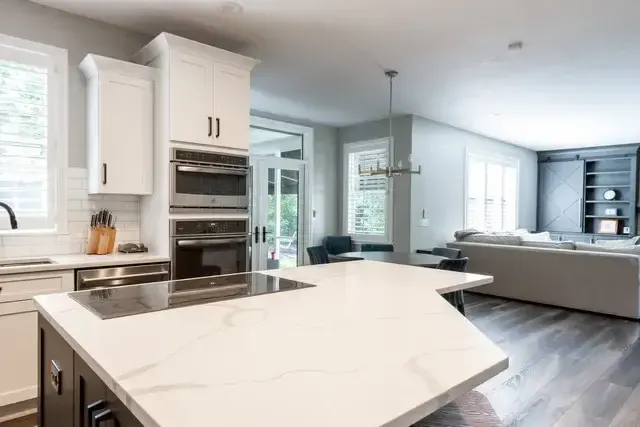
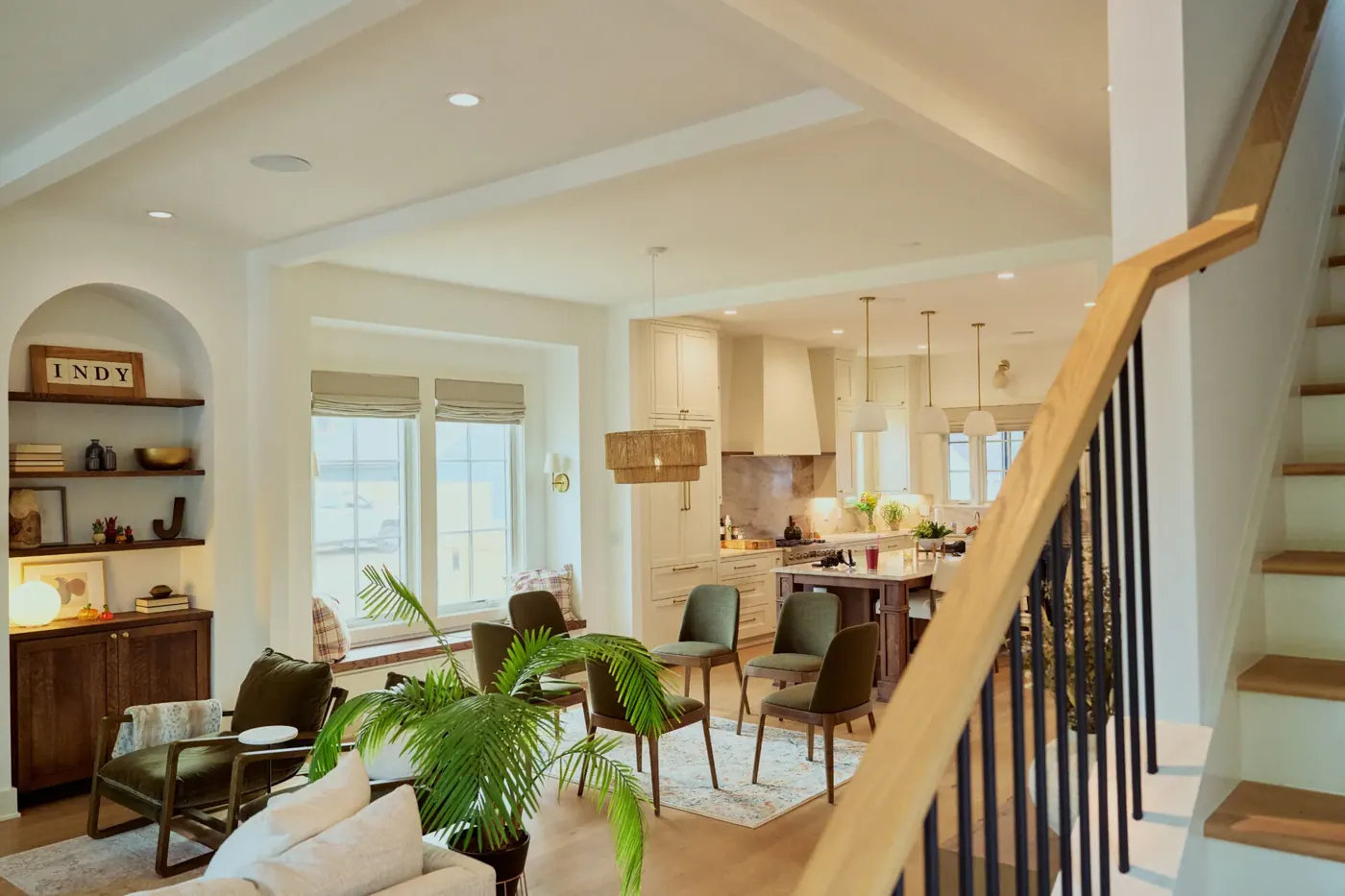
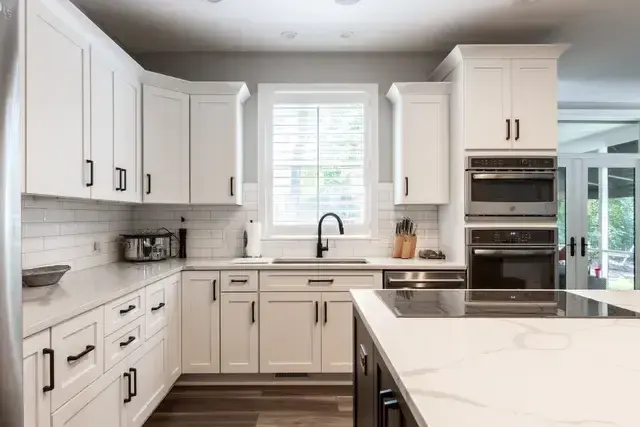
Photographs from real vertical blinds jobs completed by our crew in Indianapolis and surrounding areas.
What Vertical Blinds Includes
Every Indianapolis job is documented item by item. Here is what the crew covers.
Whole span measured across the opening rather than across the glass, since the track has to cover more than the door
Traffic flow watched at the door so the draw direction is settled before anything gets ordered
One-way draw left, one-way draw right or a center split written onto the order for each opening
Stack width calculated so parked vanes don't land across the panel you actually walk through
Three widths and three heights taken per opening with a corner-to-corner square check
Mounting depth read for the headrail and for the full vane swing where an inside mount is wanted
Ceiling, header or wall mount decided by what's genuinely there to fasten into
Vane width set, 3 1/2 inch as the standard and narrower vanes where an opening is tall and thin
Vane material specified per opening, PVC where door glass runs hot and fabric where the room wants softness
Bottom chain and weights specified or deliberately left off, depending on pets and how the door gets used
Floor clearance set so vanes clear carpet, a threshold and anything sitting near the door
Carriers, spacer chain and vane clips inspected on any existing track somebody wants to keep
Wand control set as the default, with chain and cord used only where a wand can't reach
Products specified to conform to ANSI/WCMA A100.1-2022 for cord access on every corded option
Valance or headrail cover chosen so the track doesn't read as bare hardware above the door
Handle, lock and crank positions marked so vanes clear them through a full rotation
Track leveled across the entire span so vanes hang plumb instead of walking to one end
Every vane hung, rotated through full travel and drawn end to end before we pack up
What Vertical Blinds Cost in Indianapolis
National category figures run about $60 to $600 a window for stock product and roughly $250 to $2,600 for custom fabrication. Those are published national ranges, not a quote for anything in Indianapolis. Verticals price differently from the rest of what we sell, because they price by span rather than by window. One patio opening is a single wide product, so the track length is the first number that moves. Vane material is the second: smooth PVC sits at the bottom, S-curve profiles and fabric vanes with inserts sit higher, and faux wood vanes sit higher still. Motorized lift on a wide track lands in the $300 to $1,500 installed band. Indianapolis Window Treatments measures the opening in Marion County and prices from that.
How Vertical Blinds Differ by Product
Every product in this trade behaves differently in a room. Here is what that means for this work.
3 1/2 inch PVC vane: The standard vane and the least expensive one. Smooth vinyl handles heat and sun off a door better than fabric does, wipes clean, and it's the sensible default on a west-facing patio opening that takes a beating every afternoon.
S-curve vane profile: A vane pressed into a gentle S rather than left flat. The curve stiffens it, which is why it resists curling, and it overlaps its neighbor more completely when closed, so you get a tighter face and less light straight through the joins.
Fabric vanes with a rigid insert: Fabric bonded to a vinyl carrier so it hangs straight and rotates like a vinyl vane. You get textile texture with the mechanical behavior of PVC, which is the usual answer when a living room wants softness at a wide opening.
Free-hanging fabric vanes: Fabric vanes with no insert, weighted at the bottom and often chained together. They move and drape more like drapery, which reads better in a formal room, and they're less tolerant of a drafty door pushing them around.
Faux wood vertical vanes: Composite vanes that read as a wood-look product turned on its side. They're the choice when the rest of the house has faux wood blinds and a slider needs to belong to the same family. Expect more weight on the carriers.
One-way draw: Every vane stacks to a single end of the track. It's the right call when one side of the opening is a fixed panel, because the stack parks over glass you never walk through instead of over the door you use daily.
Center split draw: Vanes part in the middle and stack toward both ends. It suits a wide opening used from either side, and it halves the stack depth at each end. On a slider it only makes sense when the traffic pattern genuinely runs through the middle.
Wand control: A single wand rotates the vanes and pulls the traverse, with no cord loop hanging beside the door. It's the cleanest thing to operate next to a threshold people walk through, and it's what we specify unless a span is too wide for it.
Bottom chain and weights: Weights sewn or clipped into each vane bottom, linked by a chain across the run. The chain keeps vanes evenly spaced and stops them swinging in a draft. Leave it off where a dog or a toddler is going to pull on it.
Fabric-wrapped cornice: A built-up cornice over the headrail instead of a plain valance, so the track disappears above a wide opening. It matters more on verticals than on other products, because a bare vertical headrail is a long piece of visible hardware.
Vertical Blinds FAQ
Questions we hear most often from Indianapolis homeowners considering vertical blinds.
Vertical Blinds Across Indianapolis
We measure and install in every one of these Indianapolis neighborhoods. Each has its own page with the build eras, window conditions and mounting notes for that section.
- Vertical Blinds in Irvington
- Vertical Blinds in Fountain Square
- Vertical Blinds in Herron
- Vertical Blinds in Lockerbie Square
- Vertical Blinds in Chatham Arch
- Vertical Blinds in Old Northside
- Vertical Blinds in Woodruff Place
- Vertical Blinds in Meridian
- Vertical Blinds in Broad Ripple
- Vertical Blinds in Butler
- Vertical Blinds in Golden Hill
- Vertical Blinds in Forest Hills
- Vertical Blinds in SoBro
- Vertical Blinds in Warfleigh
- Vertical Blinds in Crows Nest
- Vertical Blinds in Williams Creek
- Vertical Blinds in Rocky Ripple
- Vertical Blinds in Traders Point
- Vertical Blinds in Geist
- Vertical Blinds in Bates
- Vertical Blinds in Fall Creek Place
- Vertical Blinds in Nora
- Vertical Blinds in Castleton
- Vertical Blinds in Glendale
- Vertical Blinds in Devonshire
- Vertical Blinds in Speedway
- Vertical Blinds in Meridian Hills
- Vertical Blinds in Cottage Home
- Vertical Blinds in Garfield Park
Other Window Treatment Services in Indianapolis
Indianapolis Window Treatments handles the full scope of window treatment work. Explore our other services below.
Schedule Your Free In-Home Measure in Indianapolis
Reach Us Directly
Our team prioritizes scheduled measures and service calls, and books in-home measures during business hours.
Ready to Book Your Measure?
Call us to set up an in-home measure, or to ask about a treatment that has stopped working. We will talk it through on the phone first.