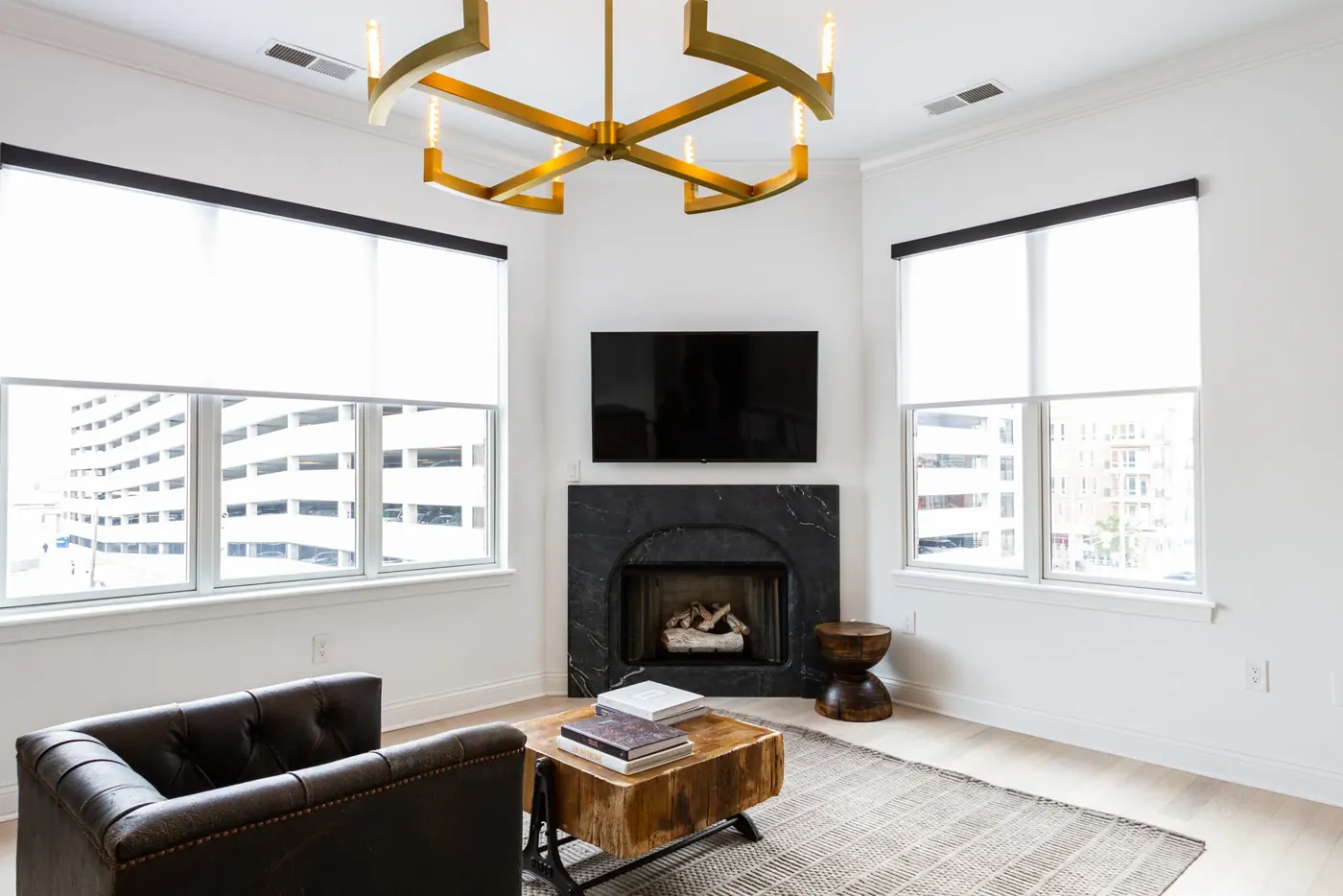
Window Treatment Serving Lockerbie Square
Custom Indianapolis window treatment crews serving Lockerbie Square homeowners with free in-home measure, repair, replacement.
If you live in this area of Indianapolis, some of these answers will sound familiar. Older openings, shallower depth and out-of-square conditions come up regularly and none of them are a problem once they're measured.
- Services: faux wood blinds, wood blinds, vertical blinds, aluminum mini blinds
- Service area: Lockerbie Square, Indianapolis, IN and surrounding areas Getting somebody out to measure is the easy part and happens on a normal schedule. After that the fabricator needs roughly two to five weeks. We give you a specific window when we write the order.
- Insured and bonded
- Serving Indianapolis, IN since 2008
Local Window Treatment Experience in Lockerbie Square
Three completely different window vocabularies sit inside six blocks here, which is the thing nobody warns you about. The Federal houses carry symmetrical multi light units with a fanlight and sidelights at the entrance. The Italianate houses carry tall narrow openings with segmental heads under heavy bracketed hoods. The Queen Anne houses carry bays, transoms and leaded margin lights. And then there are the two industrial conversions, where the openings are eight to twelve feet tall in deep masonry walls. A vernacular cottage runs 8 to 14 openings, a Federal or Italianate house 16 to 26, a Queen Anne 22 to 32, and a loft unit as few as four, each of them enormous.</p><p style="font-size:16px;color:#4a5a6a;line-height:1.75;margin:16px 0 0">The regulatory position here needs checking address by address rather than by neighborhood name, and that isn't us being cautious. The city's own historic inventory layer carries two separate values, Lockerbie Square Historic District and Lockerbie Square Historic District (NR only). That's the city recording, in its own data, that part of the National Register boundary lies outside the locally designated district. Two houses a street apart can have entirely different obligations: one needs a certificate of appropriateness for exterior work and the other needs nothing at all. It's the sharpest regulatory line in Indianapolis and it doesn't follow anything visible on the ground.
We have served Lockerbie Square homeowners through the full range of window treatment needs, from inspections and repairs to full replacements. Whatever the system, our Indianapolis crew approaches every project with clear communication and respect for your property.
1830s cottages, 1980s lofts, and some houses that arrived later than the ground
Restoration in the 1960s and 1970s did something here that changes how you measure. Period buildings were moved in from elsewhere to fill vacant lots, so a house in Lockerbie Square may not have started here. Its fabric can be 140 years old while its foundation is 55. A structure that's been lifted and moved has usually racked in the process, which means its openings can be out of square in ways that don't match how the building was originally put together. You can't reason from era to condition on a relocated house. You have to measure what's actually in front of you and accept that the diagonals may tell a strange story.
The other half of the stock arrived in the 1980s. The Indianapolis Glove Company conversion of 1984 was the city's first industrial to residential loft project, and Real Silk Hosiery Mills followed in 1986. Those buildings brought very large multi light steel and timber industrial openings in solid masonry walls into a neighborhood of small frame cottages. Lots are small nineteenth century urban parcels on a compact grid bounded by Michigan, Davidson, New York and New Jersey streets. The poet James Whitcomb Riley lived at 528 Lockerbie Street from 1893 until 1916, and that house is now the museum most visitors come to see.
Twelve foot openings and eight foot cottages, a hundred yards apart
Mounting depth runs in opposite directions inside one district. The factory conversions have masonry walls with deep reveals, which is the most generous inside mount depth anywhere in this part of the city and makes a recessed cassette or a side channel genuinely practical. The cottages are the reverse: modest frame jambs with applied casing and very little depth behind the stop. On the relocated houses, add the possibility that an opening was altered during the move. We take three widths, three heights and a diagonal at every opening here, and on the moved houses we take the diagonal twice.
Light behaves unusually too. The district is a tight rectangle on the downtown grid so fronts face the four cardinal directions, but the cobblestone streets and the very narrow rights of way mean the buildings sit close together and shade each other for much of the day. That's a different condition from a suburban lot with sky on all sides, and it changes what an openness factor does. A 5 percent fabric in a room that's already shaded by the building opposite can leave you with less usable daylight than you expected, so we look at the actual room at the actual hour before specifying.
Check which side of the boundary you're on
The city's inventory layer records an NR-only area outside the locally designated district. Before we quote anything that fixes to the outside of your building, we tell you to confirm with IHPC whether your specific address sits inside the local district. Being in Lockerbie Square isn't the test. Being inside the local boundary is, and the two aren't the same shape.
Tall industrial openings need engineering, not just measuring
An eight to twelve foot opening carries real fabric weight and real deflection across the tube. We specify tube diameter against width and drop rather than against price, add a center support bracket where the span needs one, and tell you it will be visible. Lutron notes that shades 120 inches and taller, or over a four to one height to width ratio, get larger light gaps. That's physics, not a defect.
Relocated houses rack
Buildings moved in during the 1960s and 1970s restoration have usually twisted somewhere in the process, and the openings show it. We measure the diagonal at every opening on those houses and photograph anything badly out of true. Where an opening has racked past what an inside mount can hide, you hear it at the measure and we show you the outside mount version with a header board instead.
Buildings shade each other here
Narrow rights of way and cobblestone streets put your neighbor's wall much closer than a suburban lot ever would. That mutual shading changes the openness factor argument considerably: a fabric that would be perfect on an open west elevation can leave a Lockerbie room dim. We assess the light in the room rather than from the compass direction alone before recommending 1, 3, 5 or 10 percent.
What we specify most in Lockerbie Square
The 15 percent year on year move in median sale price is the strongest of any neighborhood we track here, and it changes how people think about spending. What it shouldn't change is the order of operations. On a loft unit with four openings twelve feet tall, one product decision carries the whole room and it's worth getting the tube, the fabric weight and the control method right. On a cottage with fourteen small openings the money goes into count rather than into any single unit. National figures put motorized product at roughly $300 to $1,500 a window installed, and shutters $175 to $800.
Motorized Shades
At eight to twelve feet, reach is the whole argument. A hand chain on an opening that tall is unpleasant to use and gets used less each month. We set upper and lower travel limits at commissioning so the shade stops on the trim line rather than at a factory default, and we're upfront that Hunter Douglas puts PowerView battery life at about a year. Batteries are the most under disclosed running cost on motorized work.
Solar Shades
Industrial walls of glass in the Glove Company and Real Silk conversions produce genuine afternoon heat and glare in a way the cottages never do. Solar fabric with a stated openness factor cuts both while keeping the view that made the unit worth buying. We'll usually specify 3 percent for glare control with a view and 5 percent where the room needs more daylight, and we hang samples in your own light before you pick.
Cafe Shutters
A cottage window three feet from a narrow sidewalk has a privacy problem and a daylight problem at once, and a cafe shutter answers both. Covering the lower portion only keeps passersby out of the room while leaving the upper light open to the sky. On a nineteenth century frame opening with shallow depth we build the frame to suit rather than forcing a stock size into a hand built hole.
Blackout Shades
Downtown light and a loft with tall openings makes for bright bedrooms. Blackout fabric in a side channel with a light blocking pocket at the head is what actually darkens a room, and a blackout shade without those components still leaks around the edges. We'll show you the difference rather than let you find it out at midnight, and we'll flag that side channels can trap winter condensation against cold glass.
Getting around Lockerbie Square
The district sits immediately east of the downtown Mile Square and immediately south of Chatham Arch, bounded by Michigan, Davidson, New York and New Jersey streets. People here walk to Massachusetts Avenue for restaurants and pick up the Cultural Trail at the edge of the neighborhood. The cobblestone streets are a contributing feature of the district in their own right and they're the first thing anyone mentions about the place. The James Whitcomb Riley Museum Home at 528 Lockerbie Street anchors the south side, and the two loft buildings, the Lockerbie Glove Factory and Real Silk Hosiery Mills, anchor the industrial edge.
The People's Club, the commission and the boundary
The Lockerbie Square People's Club is a neighborhood organization rather than a mandatory homeowners association, and it holds no architectural control over your property. The regulator is IHPC, and this was the very first district it reviewed, back in 1968. Under IC 36-7-11.1-9(a) a certificate of appropriateness is required before constructing an exterior architectural structure or feature in a historic area, or altering an exterior or designated interior feature. A market description of this neighborhood puts the practical version plainly: exterior modifications require city preservation commission approval. Interior blinds, shades and drapery aren't reached in the ordinary case. Exterior awnings and exterior solar shades are. The complication unique to Lockerbie is the boundary itself, because part of the National Register area sits outside local designation, so confirm your address with IHPC rather than reasoning from the neighborhood name.
Window Treatment Services in Lockerbie Square
Every service Indianapolis Window Treatments offers across Indianapolis is available to Lockerbie Square homeowners.
Faux Wood Blinds in Lockerbie Square
Wood look, in the rooms wood can't survive
Learn more →Wood Blinds in Lockerbie Square
For conditioned rooms where the trim is the point
Learn more →Vertical Blinds in Lockerbie Square
Built for the opening you walk through
Learn more →Aluminum Mini Blinds in Lockerbie Square
Low cost per opening, specified to be reordered
Learn more →Roller Shades in Lockerbie Square
One clean plane, and nothing crossing the glass
Learn more →Solar Shades in Lockerbie Square
Cut the glare, keep the view, pick the number
Learn more →Cellular Shades in Lockerbie Square
The one product with measured energy data behind it
Learn more →Zebra Shades in Lockerbie Square
View by day, cover by night, one motion
Learn more →Roman Shades in Lockerbie Square
Soft treatment for rooms with height to fill
Learn more →Woven Wood Shades in Lockerbie Square
Natural texture, with the liner question answered first
Learn more →Blackout Shades in Lockerbie Square
Dark rooms are hardware, not fabric
Learn more →Plantation Shutters in Lockerbie Square
The frame absorbs what the opening has done
Learn more →Cafe Shutters in Lockerbie Square
Privacy at eye level, daylight above it
Learn more →Motorized Shades in Lockerbie Square
Reachable is the reason. Batteries are the cost
Learn more →Custom Drapery in Lockerbie Square
Yardage sets the price. The fixing decides the outcome
Learn more →Valances & Top Treatments in Lockerbie Square
The line that makes mismatched windows read as one
Learn more →Exterior Solar Shades in Lockerbie Square
Stop the heat outside the glass, with the district checked
Learn more →Retractable Awnings in Lockerbie Square
Shade in July, sun in January, certificate first
Learn more →Commercial Window Treatments in Lockerbie Square
Code, cycle count and phasing decide this, not fabric
Learn more →Skylight Shades in Lockerbie Square
Overhead glass, planned from the ground up
Learn more →Sliding Glass Door Blinds in Lockerbie Square
The stack has to land off the panel you use
Learn more →Panel Track Blinds in Lockerbie Square
Stack depth and stack side decide this one
Learn more →Sheer Shades in Lockerbie Square
Diffused light for windows worth looking at
Learn more →Pleated Shades in Lockerbie Square
Shallowest headrail in the trade, honestly priced
Learn more →Bamboo Shades in Lockerbie Square
Natural weave, with the liner question answered first
Learn more →Dual Shades in Lockerbie Square
Two fabrics, one tube, level or nothing
Learn more →Top-Down Bottom-Up Shades in Lockerbie Square
Daylight above, cover at eye level
Learn more →Cordless Blinds in Lockerbie Square
No cords, and a spring that's a wear part
Learn more →Hardwood Shutters in Lockerbie Square
Real wood, in rooms that stay conditioned
Learn more →Composite Shutters in Lockerbie Square
For damp rooms, with the weight planned for
Learn more →Smart Home Shade Integration in Lockerbie Square
Protocol first, range second, hub risk disclosed
Learn more →Blind Repair & Restring in Lockerbie Square
We check the headrail before quoting the labor
Learn more →Shutter Repair in Lockerbie Square
Matchable or not, established before we schedule
Learn more →Motorization Retrofit in Lockerbie Square
Not every headrail takes a motor. We check first
Learn more →Outdoor Patio Shades in Lockerbie Square
Wind decides this. Anchor into structure, not trim
Learn more →Office Window Treatments in Lockerbie Square
Control height and openness factor, then fabric
Learn more →Healthcare Window Treatments in Lockerbie Square
Test documentation, cordless throughout, cleanable surface
Learn more →Multifamily Window Treatments in Lockerbie Square
One written spec per floor plan, dye lots disclosed
Learn more →Communities We Serve Around Indianapolis
Lockerbie Square is one of several Indianapolis communities we serve. We measure and install across Indianapolis, Marion County, and surrounding areas.
Lockerbie Square Window Treatment FAQ
Questions we hear most often from Lockerbie Square homeowners.
Free Assessment in Lockerbie Square
Schedule a free, no-obligation window covering inspection. We respond promptly to all Lockerbie Square inquiries.