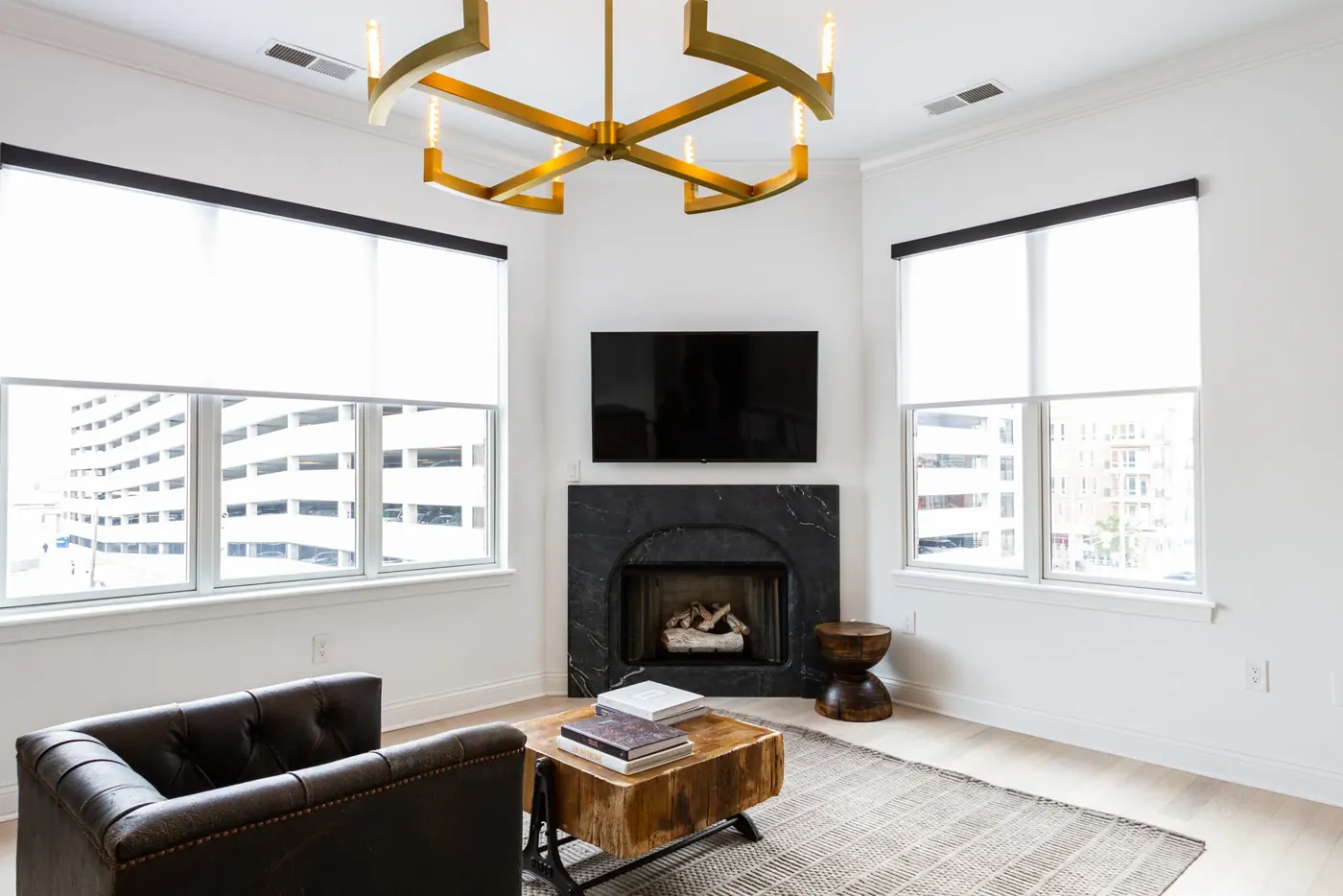
Faux Wood Blinds Across Indianapolis, IN
Wood look, in the rooms wood can't survive
What follows is what we'd tell you in person about this service, including which rooms it belongs in and which ones it doesn't. That second list is shorter but it saves more money.
- Service: Faux Wood Blinds for Indianapolis homeowners
- Service area: Indianapolis, IN and surrounding areas Nothing in window treatments needs a middle-of-the-night call-out. What matters is the fabrication window, typically two to five weeks. Service and repair work sits outside that and gets handled on a much shorter timeline.
- Insured and bonded
- Serving Indianapolis, IN since 2008
Expert Faux Wood Blinds for Indianapolis Homes
Faux wood is the blind we specify most often in Indianapolis, and the reason is the calendar rather than the price list. The muggy season here runs about 3.9 months, roughly 25 May to 22 September, and July alone carries 16.6 muggy days. Then the heating season pulls that moisture back out of the house for three months. PVC and composite slats don't care about the cycle. Basswood does, and a bathroom or a laundry room is where you find that out.
The second reason is this city's tenure split. 159,622 of 362,961 Indianapolis households rent, which is 44 percent, and rental and multifamily work needs a product that survives turnover and can be reordered to the same specification three years later. A 2 inch faux wood in a standard finish does that. It also takes a knock from a vacuum without denting, which a hardwood slat does not, and it wipes down rather than needing care.
Where faux wood struggles is width. PVC slats bow on long unsupported spans and heat accelerates it, so a west facing run past about 60 inches wants a center support bracket or a split into two blinds under one continuous valance. We tell you which of your openings fall into that at the measure. A bowed slat isn't a warranty item once the span was known at the time the order went in.
Signs You Need Faux Wood Blinds
If you notice any of these in your Indianapolis home, it is worth booking a measure. None of it is urgent, and none of it fixes itself either.
Wood blinds in the bathroom have warped or the finish has checked
Slats sag in the middle of a wide living room opening
Ladder strings have frayed or snapped on an older blind
A rental unit needs the same specification reordered for turnover
The kitchen window sits over the sink and takes steam daily
You want the look of wood in a room that swings humid
Existing blinds have yellowed on the west elevation
The tilt wand has snapped off at the rod
How Indianapolis Window Treatments Handles Faux Wood Blinds
Every job follows the same six-step process. Transparent, thorough, and done right the first time.
Room by room material call
We walk the house and split the openings into conditioned and unconditioned before anybody talks about color. Bathrooms, kitchens, laundry rooms and any unheated sunroom go composite or PVC. A conditioned study or bedroom can take hardwood instead if you prefer the grain. That split is the point of the appointment, and it gets made on humidity rather than on budget.
Three point measure and diagonal
Every opening gets three widths, three heights and a diagonal check, with laser readings reduced by a sixteenth. In pre-1980 Indianapolis stock, which is 59.2 percent of the city, the narrowest width and the longest height are what an inside mount has to live with. Where the diagonal says an opening has racked past tolerance, we convert it to an outside mount there and then.
Depth checked at the stop
A 2 inch faux wood headrail needs real depth to sit inside the opening, and the figure isn't the same across product lines. We measure the reveal at the stop on each opening and check it against the line you're choosing. On a 1920s bungalow with an interior storm panel fitted, that check usually decides the mount type before anything else does.
Span, supports and splits
Anything wide gets planned rather than simply ordered. We work out where a center support bracket lands, or whether the opening is better served by two blinds under one continuous valance so the slats never sag. On a west elevation we lower that threshold, because heat accelerates bowing in PVC and a long unsupported span shows it within a couple of summers.
Order with safety hardware
Product gets ordered built to ANSI/WCMA A100.1-2022, the governing product safety standard for corded window coverings. Cordless lift is the default in any room a child uses. Where a corded configuration is genuinely necessary, a chain tensioner is fitted rather than left in the box, because an untensioned loop is a standard violation and not a cosmetic detail.
Install and set the tilt
Brackets go into the substrate we identified at the measure, which in the pre-1940 districts means finding the casing or the stud behind the plaster rather than trusting the plaster itself. Blinds get hung, the tilt is run through its full travel and tested, and hold down brackets go onto any unit fitted to a door that swings.
Faux Wood Blinds in Indianapolis
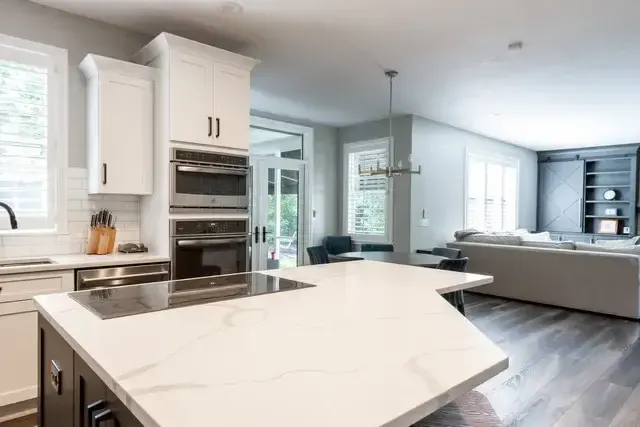
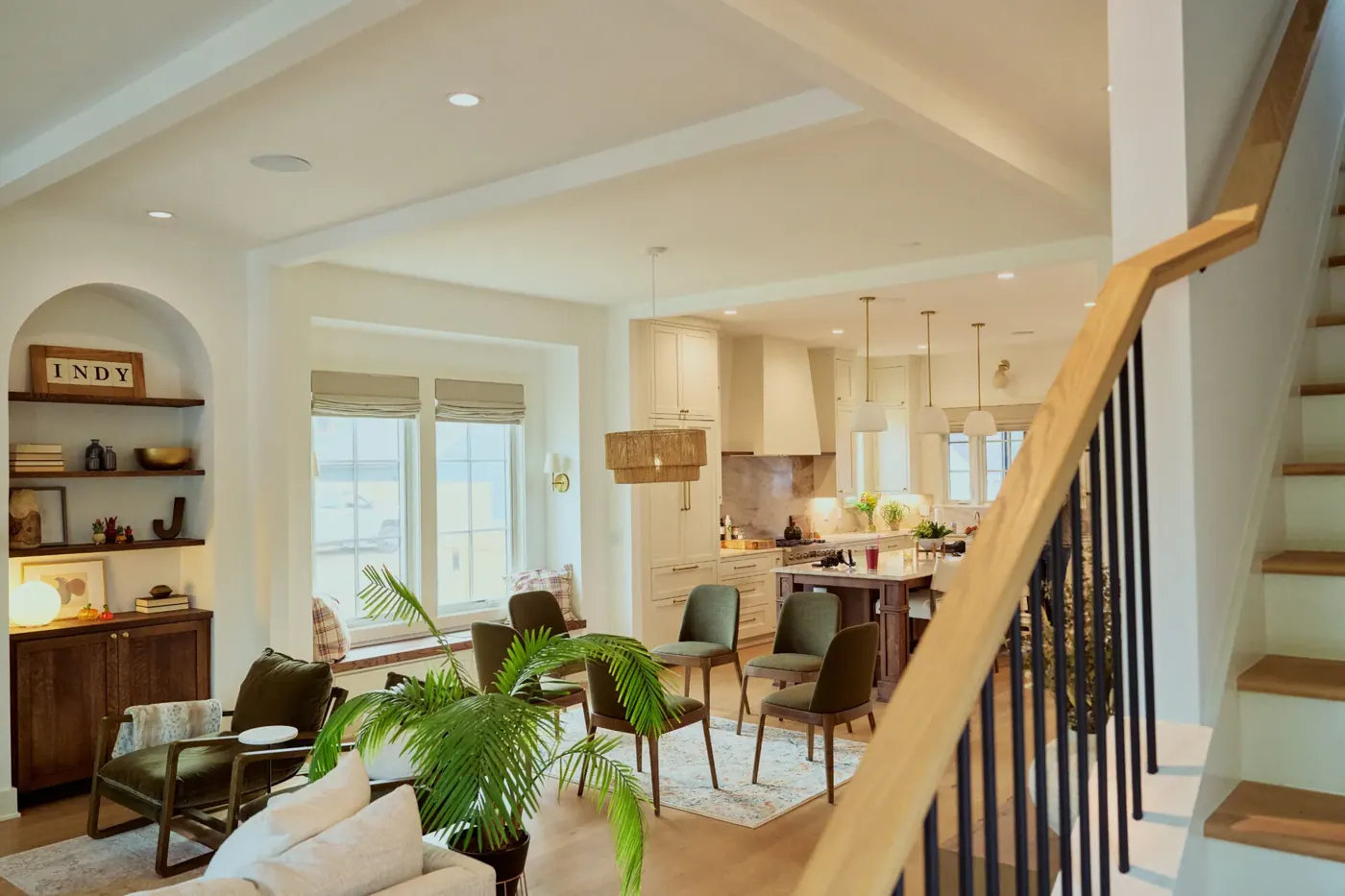
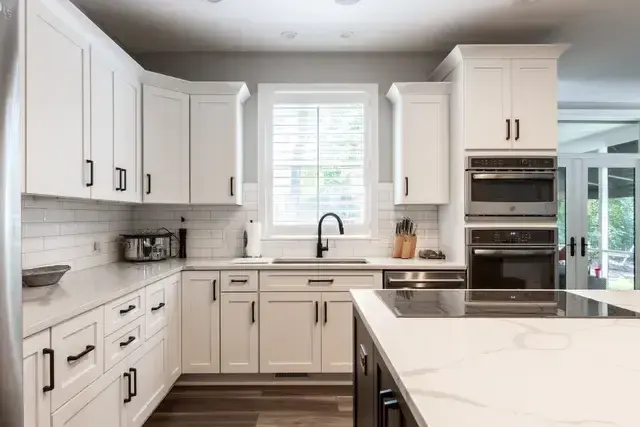
Photographs from real faux wood blinds jobs completed by our crew in Indianapolis and surrounding areas.
What Faux Wood Blinds Includes
Every Indianapolis job is documented item by item. Here is what the crew covers.
Every opening measured three widths and three heights, then checked corner to corner for square
Room moisture read before the material call, so baths, kitchens, laundry rooms and finished basements get faux wood
Mounting depth taken at the top of the opening so a 2 inch headrail clears the trim and any hardware
Solid PVC and wood-polymer composite separated on the order, because they don't weigh the same or behave the same
West and south openings flagged, since surface heat on a dark slat is what starts a bow
Slat size set per opening, 2 inch as the standard and 2 1/2 inch where the window is wide enough to carry it
Center support bracket planned on any span wide enough to let a loaded headrail settle in the middle
Wide openings split two-on-one so no single blind carries more weight than its brackets should
Finished weight checked against the opening before a wide unit gets ordered as one piece
Routeless slats specified where a row of lit route holes would be noticed from inside the room
Cloth tape ladders offered where the route holes should disappear behind a band of fabric
Tilt wand set as the default, with cord tilt only where a wand can't clear a handle or a return
Cordless lift specified in rooms that kids and pets actually use
Products specified to conform to ANSI/WCMA A100.1-2022 for cord access
Valance style and return depth chosen so an outside mount really closes off the sides
Factory deduction left with the manufacturer so the allowance never gets taken twice
Light gap per side written onto the paperwork before the order goes to the factory
Old blinds pulled, brackets removed, and every new unit tilted and lifted end to end before we leave
What Faux Wood Blinds Cost in Indianapolis
National category figures put stock blinds and shades near $60 to $600 a window, with custom-fabricated units running roughly $250 to $2,600. Those are published national ranges for the category, not a quote for any address in Indianapolis. Faux wood lands low in that band, which is most of why people choose it. A 2 inch composite blind on an ordinary bathroom opening is inexpensive work. Price climbs when the opening gets wide, because weight is the real constraint here: a wide span wants a center support bracket or a two-on-one headrail, and both add parts and install time. Routeless slats, cloth tapes and a cordless lift each move the number as well. Indianapolis Window Treatments prices from measured openings around Marion County, never from a per-window average.
How Faux Wood Blinds Differ by Product
Every product in this trade behaves differently in a room. Here is what that means for this work.
2 inch faux wood slat: The size most houses around here want, and the one we start from. It gives you a real view between open slats without the stack a wider slat builds at the top, and it stays flat across an ordinary bath or bedroom opening.
2 1/2 inch faux wood slat: Fewer slats over the same height, so the face reads cleaner and the open view improves. It also weighs more per running foot, which is exactly why we settle the span and the bracket plan before writing it onto a wide window.
Solid PVC slats: The least expensive construction we hang and the most waterproof. It's also the heaviest, and it's the one most willing to take a bow on hot glass, so we keep it to smaller openings and off the west wall in July.
Wood-polymer composite slats: Wood flour blended with polymer, stiffer and lighter than solid PVC at the same slat size. It costs a bit more and it holds a straight line better on a wide opening or a sunny one, so it's what we specify by default.
Routeless slats: The lift cord runs through a notch at the back edge instead of a hole punched through the face. With the blind closed there's no row of pinholes glowing at you across a dark bedroom. It costs more and it earns it there.
Cloth tape ladders: A woven tape that hides the route holes and lays a color band down the face of the blind. It changes the look more than anything else on the order, and it narrows the view slightly wherever a tape crosses a slat.
Cordless lift: A constant-force spring inside the headrail in place of a lift cord. It's what goes into rooms children use. On a heavy faux wood unit it wants a hand near each end of the bottom rail rather than one hand in the middle.
Tilt wand: A clear or color-matched wand that turns the tilt mechanism. Nothing hangs loose off the headrail, it clears a door handle better than a cord loop does, and it's the default we begin from on almost every faux wood job.
Center support bracket: An extra bracket carried under the middle of a long headrail. On a wide faux wood blind that bracket isn't decoration, it's what keeps the rail from taking a set and the slats from dragging harder on one side than the other.
Two-on-one headrail: Two blinds sharing a single continuous headrail across a wide opening, each with its own lift and tilt. It keeps each unit at a weight the brackets and your arm can manage, and the split position gets written on the order so nobody guesses.
Faux Wood Blinds FAQ
Questions we hear most often from Indianapolis homeowners considering faux wood blinds.
Faux Wood Blinds Across Indianapolis
We measure and install in every one of these Indianapolis neighborhoods. Each has its own page with the build eras, window conditions and mounting notes for that section.
- Faux Wood Blinds in Irvington
- Faux Wood Blinds in Fountain Square
- Faux Wood Blinds in Herron
- Faux Wood Blinds in Lockerbie Square
- Faux Wood Blinds in Chatham Arch
- Faux Wood Blinds in Old Northside
- Faux Wood Blinds in Woodruff Place
- Faux Wood Blinds in Meridian
- Faux Wood Blinds in Broad Ripple
- Faux Wood Blinds in Butler
- Faux Wood Blinds in Golden Hill
- Faux Wood Blinds in Forest Hills
- Faux Wood Blinds in SoBro
- Faux Wood Blinds in Warfleigh
- Faux Wood Blinds in Crows Nest
- Faux Wood Blinds in Williams Creek
- Faux Wood Blinds in Rocky Ripple
- Faux Wood Blinds in Traders Point
- Faux Wood Blinds in Geist
- Faux Wood Blinds in Bates
- Faux Wood Blinds in Fall Creek Place
- Faux Wood Blinds in Nora
- Faux Wood Blinds in Castleton
- Faux Wood Blinds in Glendale
- Faux Wood Blinds in Devonshire
- Faux Wood Blinds in Speedway
- Faux Wood Blinds in Meridian Hills
- Faux Wood Blinds in Cottage Home
- Faux Wood Blinds in Garfield Park
Other Window Treatment Services in Indianapolis
Indianapolis Window Treatments handles the full scope of window treatment work. Explore our other services below.
Schedule Your Free In-Home Measure in Indianapolis
Reach Us Directly
Our team prioritizes scheduled measures and service calls, and books in-home measures during business hours.
Ready to Book Your Measure?
Call us to set up an in-home measure, or to ask about a treatment that has stopped working. We will talk it through on the phone first.