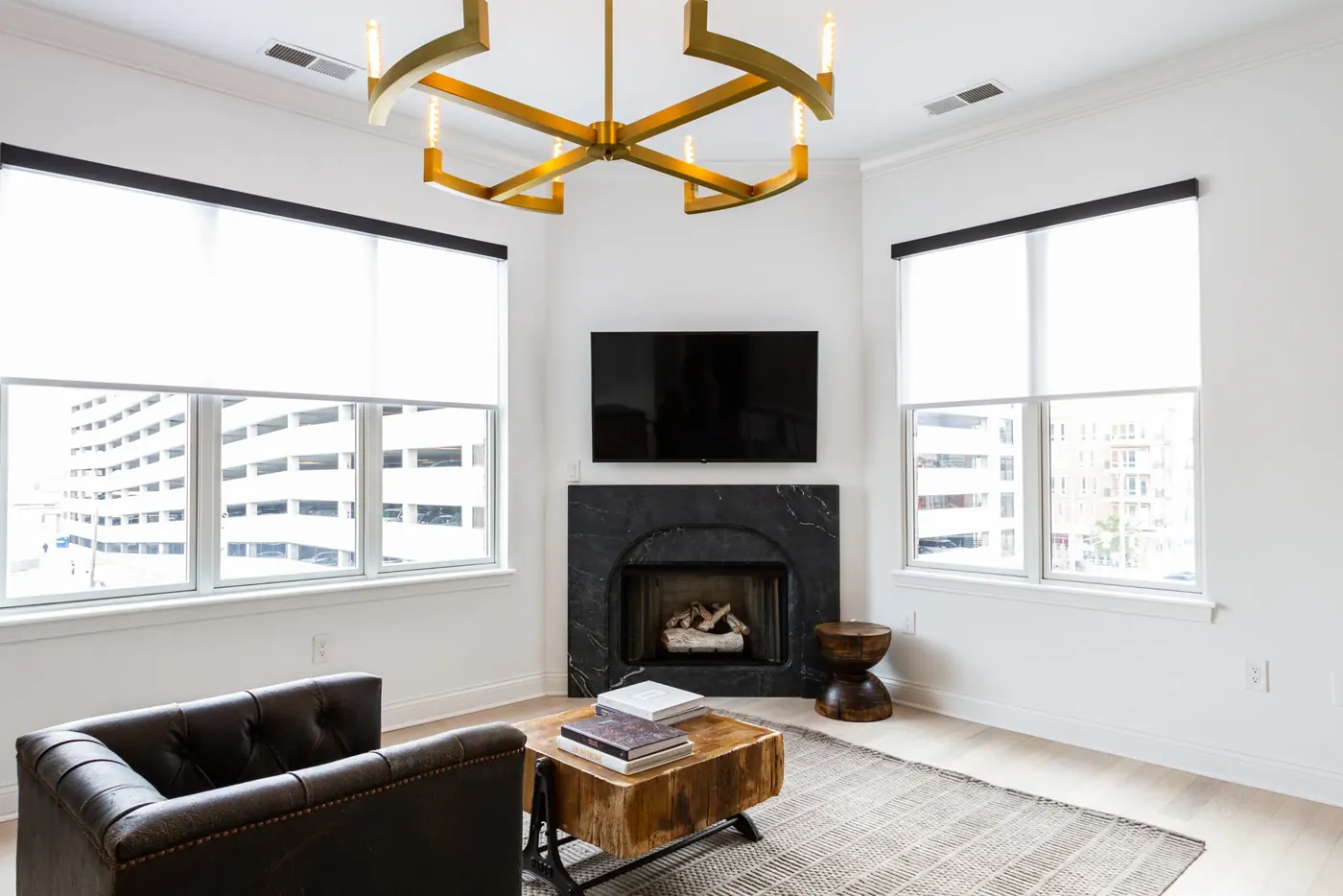
Glendale Window Treatment, Indianapolis, IN
Custom Indianapolis window treatment crews serving Glendale homeowners with free in-home measure, repair, replacement.
If you live in this area of Indianapolis, some of these answers will sound familiar. Older openings, shallower depth and out-of-square conditions come up regularly and none of them are a problem once they're measured.
- Services: faux wood blinds, wood blinds, vertical blinds, aluminum mini blinds
- Service area: Glendale, Indianapolis, IN and surrounding areas Getting somebody out to measure is the easy part and happens on a normal schedule. After that the fabricator needs roughly two to five weeks. We give you a specific window when we write the order.
- Insured and bonded
- Serving Indianapolis, IN since 2008
Local Window Treatment Experience in Glendale
The houses around this center went up alongside it, which puts them in the biggest and most predictable era block in the city. Expect roughly 10 to 16 openings on a 1950s ranch and 12 to 18 on a split level spread across two sill heights. Expect shallow frame jambs, and on the 1960s work aluminum frames whose horizontal track hardware leaves very little flat surface. Expect no arched heads, no transoms and no big room glass anywhere in the residential stock. Those counts are our reading of the era rather than a Glendale survey, but the mounting conditions are consistent enough to plan around.</p><p style="font-size:16px;color:#4a5a6a;line-height:1.75;margin:16px 0 0">There's no historic designation of any kind over any of this. Glendale doesn't appear in the Indianapolis Historic Preservation Commission's map layer or in the city's historic sites inventory, so nothing here needs a certificate of appropriateness, inside or out. That matters more than it sounds, because this area sits between Broad Ripple and the north side corridors where National Register districts are common and people assume the rules travel with the postcode. They don't. On this ground an exterior solar shade or a retractable awning is a product decision rather than an application.
We have served Glendale homeowners through the full range of window treatment needs, from inspections and repairs to full replacements. Whatever the system, our Indianapolis crew approaches every project with clear communication and respect for your property.
A 1950s residential wave around a center that shrank
The residential streets here were built out in the same 1950s and 1960s wave that produced the shopping center, which places them squarely in the shallow jamb regime that covers 43.5 percent of this city's housing. The dominant Marion County stock of that period is ranch, minimal traditional and split level, predominantly single story with split levels mixed in, and that's what the streets around Keystone and 62nd carry. No home count, price band or style inventory was published for the residential area specifically, so we're plain that our expectations come from the era rather than from a Glendale specific record.
The center itself is a different building type and a different job. The original 685,000 square feet designed by Victor Gruen was frequently the first local branch location away from established flagship stores downtown, and it lost tenants over decades to The Fashion Mall at Keystone two miles north, which is why the site was rebuilt rather than extended. The current 393,002 square foot open air center is owned by Kite Realty and anchored by Target, Lowe's, Landmark Theatres and an Indianapolis Public Library branch, which is an unusual civic and retail combination and the thing residents use to place the whole area.
Shallow jambs on a cardinal grid, plus storefront work
The center sits at Keystone Avenue and 62nd Street on the cardinal grid, so the residential streets around it run north south and east west and fronts face one of four directions. That's more predictable than the curving plats further north: one side of each north south street takes the low afternoon sun straight onto the front elevation, and the houses on the numbered streets take north or south fronts. Sixty to seventy five years of settlement means out of square is the default, so three widths, three heights and a diagonal on every opening, with laser readings reduced by a sixteenth.
There's a second kind of work here that most residential neighborhoods don't have on their doorstep. The rebuilt open air format carries modern storefront glass, and commercial work on that is a different specification entirely: control heights, phased installation around trading hours, spec compliance and warranty terms in writing. A library branch, a theater and big box anchors each have different requirements from each other, let alone from a house. We keep those conversations separate rather than quoting a shop the way we'd quote a living room.
The wide low front opening
The defining unit of the 1950s houses here: a fixed center panel with operable flankers running wide across the front on a thin wall. One headrail spanning it sags where you can see it. We split it into two treatments under a single continuous fascia or valance, which keeps the head line unbroken and lets you operate one half without the other.
Aluminum era mounting depth
On the 1960s openings the track hardware sits where a bracket wants to land. Rather than forcing an inside mount into a quarter inch that doesn't exist, we mount on the face of the trim or above it, size the overlap and return properly, and check clearance against handles and locks. The result covers more of the opening and closes most of the light gap anyway.
Low ceilings change the drapery answer
Ranch and minimal traditional houses have modest ceiling heights, and a heavy top treatment eats what height there is. Where drapery suits the room, we mount the rod close to the ceiling and let the panels run the full drop, which makes the wall read taller. A deep valance on an eight foot wall does the opposite.
Storefront glass is its own scope
Retail and civic openings along the center have different drivers from a house: control heights people can reach safely, installation phased around trading hours, and specifications that have to be met rather than preferred. We survey those on site and quote scope, sequence and warranty terms in writing rather than adapting a residential quote upward.
What we specify around Glendale
In the houses the problems are heat on the west fronts, mounting depth on almost everything, and a wide opening on the front elevation that wants splitting. In the commercial fabric the problems are reach, durability and coordination. Because there's no design review here at all, the outside the glass options are available on the residential side, which is the fastest way to fix a west facing living room that becomes unusable from four o'clock in July.
Cellular shades through the house
The best all round fit for this stock. Cellular fabric works on both the heating and cooling season, which suits a climate with real loads at both ends, and it mounts cleanly outside a shallow opening. DOE and Oak Ridge National Laboratory testing measured up to 20 percent of heating energy saved and up to 15 percent of total heating and cooling energy against a bare window, which is test data rather than a promise about your bill.
Faux wood blinds
The practical default in bathrooms, kitchens and laundry rooms, where the humidity swing from late May through September and back through a heated winter moves real wood every year. Faux wood slats hold their shape, tilt for privacy without shutting the room down, and take an outside mount happily on a shallow aluminum framed opening. They also cost a fraction of a shutter, which matters across ten to eighteen openings.
Retractable awnings on the west side
No approval needed here, and nothing interior does as much for July heat as stopping the sun before it reaches the glass. On a ranch with a wide west facing front or a rear patio, an awning changes the room rather than just the glare. Installed cost nationally runs roughly $1,000 to $6,000 depending on projection and whether it's motorized, and a sun sensor is worth pricing.
Commercial roller shades on a written scope
For the retail and civic tenants along the center, roller shades on a specified fabric and openness with a defined control height are the workhorse. What matters more than fabric is the paperwork and the sequence: submittals, lead time, phased installation around trading hours, and warranty terms set out before the order rather than assumed.
Streets, landmarks and schools
Everything here is described by the center and by Keystone Avenue. Glendale Town Center sits at 6101 North Keystone Avenue at 62nd Street, with Rural Street, East 61st Street and Broad Ripple Avenue running nearby, and residents give directions by the Target, the Landmark Theatres or the Indianapolis Public Library branch inside the center rather than by street name. Broad Ripple lies immediately west and SoBro to the south, with Devonshire northeast. The Monon Trail is close. Schools are MSD Washington Township, feeding North Central High School.
Window Treatment Services in Glendale
Every service Indianapolis Window Treatments offers across Indianapolis is available to Glendale homeowners.
Faux Wood Blinds in Glendale
Wood look, in the rooms wood can't survive
Learn more →Wood Blinds in Glendale
For conditioned rooms where the trim is the point
Learn more →Vertical Blinds in Glendale
Built for the opening you walk through
Learn more →Aluminum Mini Blinds in Glendale
Low cost per opening, specified to be reordered
Learn more →Roller Shades in Glendale
One clean plane, and nothing crossing the glass
Learn more →Solar Shades in Glendale
Cut the glare, keep the view, pick the number
Learn more →Cellular Shades in Glendale
The one product with measured energy data behind it
Learn more →Zebra Shades in Glendale
View by day, cover by night, one motion
Learn more →Roman Shades in Glendale
Soft treatment for rooms with height to fill
Learn more →Woven Wood Shades in Glendale
Natural texture, with the liner question answered first
Learn more →Blackout Shades in Glendale
Dark rooms are hardware, not fabric
Learn more →Plantation Shutters in Glendale
The frame absorbs what the opening has done
Learn more →Cafe Shutters in Glendale
Privacy at eye level, daylight above it
Learn more →Motorized Shades in Glendale
Reachable is the reason. Batteries are the cost
Learn more →Custom Drapery in Glendale
Yardage sets the price. The fixing decides the outcome
Learn more →Valances & Top Treatments in Glendale
The line that makes mismatched windows read as one
Learn more →Exterior Solar Shades in Glendale
Stop the heat outside the glass, with the district checked
Learn more →Retractable Awnings in Glendale
Shade in July, sun in January, certificate first
Learn more →Commercial Window Treatments in Glendale
Code, cycle count and phasing decide this, not fabric
Learn more →Skylight Shades in Glendale
Overhead glass, planned from the ground up
Learn more →Sliding Glass Door Blinds in Glendale
The stack has to land off the panel you use
Learn more →Panel Track Blinds in Glendale
Stack depth and stack side decide this one
Learn more →Sheer Shades in Glendale
Diffused light for windows worth looking at
Learn more →Pleated Shades in Glendale
Shallowest headrail in the trade, honestly priced
Learn more →Bamboo Shades in Glendale
Natural weave, with the liner question answered first
Learn more →Dual Shades in Glendale
Two fabrics, one tube, level or nothing
Learn more →Top-Down Bottom-Up Shades in Glendale
Daylight above, cover at eye level
Learn more →Cordless Blinds in Glendale
No cords, and a spring that's a wear part
Learn more →Hardwood Shutters in Glendale
Real wood, in rooms that stay conditioned
Learn more →Composite Shutters in Glendale
For damp rooms, with the weight planned for
Learn more →Smart Home Shade Integration in Glendale
Protocol first, range second, hub risk disclosed
Learn more →Blind Repair & Restring in Glendale
We check the headrail before quoting the labor
Learn more →Shutter Repair in Glendale
Matchable or not, established before we schedule
Learn more →Motorization Retrofit in Glendale
Not every headrail takes a motor. We check first
Learn more →Outdoor Patio Shades in Glendale
Wind decides this. Anchor into structure, not trim
Learn more →Office Window Treatments in Glendale
Control height and openness factor, then fabric
Learn more →Healthcare Window Treatments in Glendale
Test documentation, cordless throughout, cleanable surface
Learn more →Multifamily Window Treatments in Glendale
One written spec per floor plan, dye lots disclosed
Learn more →Communities Close to Indianapolis
Glendale is one of several Indianapolis communities we serve. We measure and install across Indianapolis, Marion County, and surrounding areas.
Glendale Window Treatment FAQ
Questions we hear most often from Glendale homeowners.
Free Assessment in Glendale
Schedule a free, no-obligation window covering inspection. We respond promptly to all Glendale inquiries.