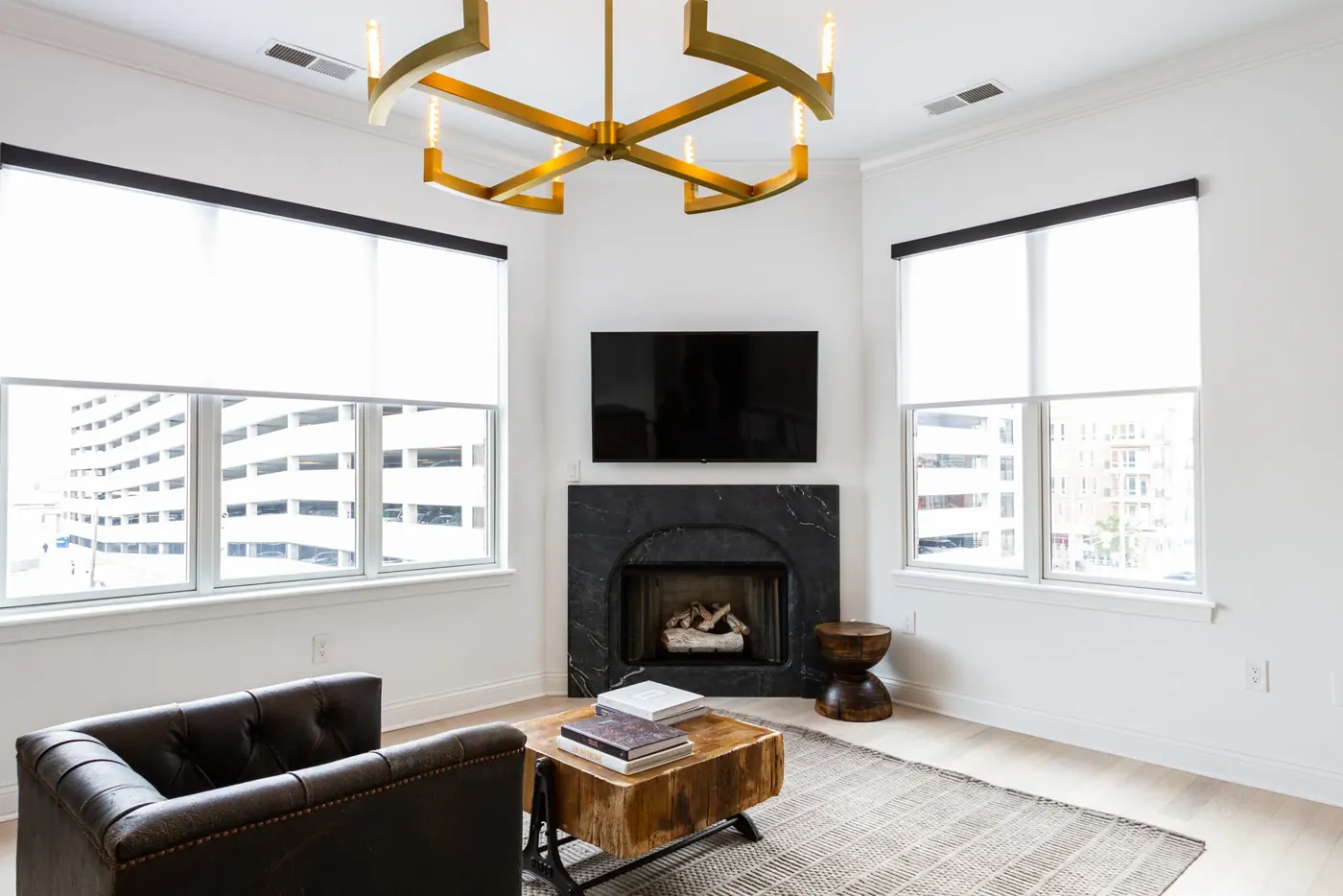
Fountain Square Window Treatment, Indianapolis, IN
Custom Indianapolis window treatment crews serving Fountain Square homeowners with free in-home measure, repair, replacement.
If you live in this area of Indianapolis, some of these answers will sound familiar. Older openings, shallower depth and out-of-square conditions come up regularly and none of them are a problem once they're measured.
- Services: faux wood blinds, wood blinds, vertical blinds, aluminum mini blinds
- Service area: Fountain Square, Indianapolis, IN and surrounding areas Getting somebody out to measure is the easy part and happens on a normal schedule. After that the fabricator needs roughly two to five weeks. We give you a specific window when we write the order.
- Insured and bonded
- Serving Indianapolis, IN since 2008
Local Window Treatment Experience in Fountain Square
This is the smallest opening neighborhood we work in. A nineteenth century worker cottage on Woodlawn or Spruce carries 8 to 14 openings, a bungalow 12 to 18, an American Foursquare 16 to 24 and a new townhouse 8 to 16. The commercial blocks around the square run 6 to 16 upper floor openings plus a full width bay of storefront glass at street level. That spread matters more than it sounds, because a small count changes the economics of a custom order. On an eight opening cottage the difference between stock and custom is a few hundred dollars, not a few thousand.</p><p style="font-size:16px;color:#4a5a6a;line-height:1.75;margin:16px 0 0">The other thing that makes Fountain Square its own problem is the geometry. Virginia Avenue runs diagonally toward the near southeast out of downtown while Prospect and Shelby sit on the cardinal grid, so the buildings where they meet present wedge shaped elevations that face several directions at once. Two shops on the same square can have completely different sun, and so can the apartments above them. Before we talk openness factor we want to know which face of the wedge the room is on and what time of day it gets uncomfortable.
We have served Fountain Square homeowners through the full range of window treatment needs, from inspections and repairs to full replacements. Whatever the system, our Indianapolis crew approaches every project with clear communication and respect for your property.
Two building populations, fifty dormant years apart
The commercial core grew over roughly seventy years, from the 1864 street railway turnaround through the 1892 viaduct to the 1930s, and then it stopped. Building didn't restart in any real way until the 1990s. What that leaves on the market today is a genuinely bimodal stock: restored 1890s houses at one end and 2023 new construction at the other, with almost nothing built in between. At its 1920s peak the neighborhood ran as many as seven cinemas at once, the Sanders, later the Apex, from 1914 to 1952 and the Fountain Square Theatre from 1928 to 1960 among them. That's why the commercial fabric is theater scale rather than shop scale.
The residential styles are early twentieth century bungalow, American Foursquare and nineteenth century worker cottage, sitting alongside two and three story commercial blocks on the square itself and contemporary townhouses on the infill sites. German, Irish, Italian and Danish immigrant merchants and builders put up the original fabric. Lots are compact on the near south side grid, with zero lot line commercial frontage along Virginia Avenue, Prospect and Shelby. There have been two fountains, not one: the 1889 original went up on merchant money and came down about thirty years later after an advertising banner was anchored to it.
Transom bands, three casing regimes and a fifty year gap
The signature condition here is the storefront transom band, a horizontal run of small lights above the display glass on the commercial blocks. It's an awkward thing to cover and an easy thing to get wrong. Drop a shade to the head of the display bay and you lose the transom band entirely; mount above the band and you're carrying a much taller product on a wider bracket span. The 1920s cinema buildings are a separate case again, with large blank walls and openings at marquee scale. On the residential side you get tall narrow units with door transoms, plus banded groupings under the broad eaves of the bungalows.
Casing splits three ways inside a few hundred feet, which is unusual even for Indianapolis. Masonry commercial reveals give you generous depth. Modest frame residential jambs with applied casing give you shallow depth. The new townhouse stock has drywall returns and no applied casing at all, so there's nothing to face fix to. Squareness splits the same way. The historic buildings are 90 to 160 years old and out of square; the 2023 work is dead square and still settling. There's very little in between because the neighborhood built almost nothing between the 1940s and the 1990s.
Check the polygon before the product
The IHPC layer draws this district as three separate polygons following commercial frontages, not as one continuous area. A house a street away from a designated frontage may sit outside the local district while still being in Fountain Square to its owner. We treat the boundary as an address by address question and tell you to confirm it with IHPC rather than assuming from the neighborhood name.
Transom bands need a decision, not a default
A storefront with a transom band above the display glass has two possible head positions and they give completely different results. We measure both, show you the bracket span and the stack height each one produces, and let you decide whether the band stays visible. On a wide bay we'll usually specify a center support bracket, which is visible, so you hear about it beforehand.
New construction is a different trade
The 2023 townhouses here have factory square openings and drywall returns with no casing. That's the opposite problem from a cottage: depth is fine, but there's no trim to fix a bracket into and the returns are easy to damage. We anchor into framing rather than into the return, and we're honest that outside mount hardware on a bare drywall reveal shows more than it does on built up casing.
Eight openings changes the math
A worker cottage with 8 to 14 openings is the one house type where doing everything in one order is genuinely affordable. It also means dye lot discipline matters more, not less, because a single mismatched replacement is a larger share of the room. We record the line, the color and the dye lot at install so a later addition can be checked before it's ordered.
What we specify most in Fountain Square
Two conversations happen here and they need different answers. The residential one is about small counts and compact rooms, where stack height and how much glass a raised shade gives back matter more than they would in a bigger house. The commercial one is about street facing glass, afternoon heat on a west facing wedge and whether anything you fix outside the building needs a certificate first. National figures put custom shades at roughly $250 to $2,600 a window and motorized product at $300 to $1,500 installed. Those are national ranges and the commercial side often runs to a different budget line than the residential side.
Roller Shades
Compact rooms reward a product that disappears. A roller on a slim cassette clears the opening almost completely when it's up, which on a cottage window that's already short in the head is the difference between a room that feels open and one that doesn't. We decide roll direction at the measure rather than at install, because a reverse roll clears deep casing and a regular roll sits tighter to the glass.
Zebra Shades
Banded shades earn their place on the wedge shaped corner elevations where the sun arrives at an awkward hour and then leaves. You get a view through position and a privacy position on the same tube without swapping product. On a street facing ground floor in a walkable neighborhood that's a real advantage, though we'll say plainly that the alternating bands don't give you true blackout.
Cellular Shades
The 1890s cottages here have small rooms and single story walls, and they lose heat quickly in January when the average high is 36.1F. DOE and Oak Ridge testing measured up to 20 percent of heating energy saved against a bare window. On a compact cottage bedroom a double cell shade in a light blocking pocket is the most useful thing you can put in the opening.
Commercial Window Treatments
Storefronts on Virginia Avenue, Prospect and Shelby have their own set of problems: full width bays, transom bands, display lighting and a landlord who may have views. We quote commercial work off a measured schedule with the head position agreed in writing, and where the address sits inside one of the three IHPC polygons we flag anything exterior before it goes on an order.
Getting around Fountain Square
The neighborhood centers on Virginia Avenue where it meets Prospect and Shelby, on the near southeast side. Fletcher Place, also an IHPC historic district, adjoins to the northwest along Virginia Avenue, and Bates-Hendricks lies to the west. People here describe getting downtown along Virginia Avenue or on the Cultural Trail, and the IndyGo Red Line runs through. The second fountain commemorates congressman Ralph Hill and carries Myra Reynolds Richards's sculpture The Pioneer Family; it stood from 1924 to 1954, was pulled for traffic, and came back from Garfield Park in 1969. The neighborhood became one of six designated Indianapolis cultural districts in 1999.
Who reviews what in Fountain Square
There's no homeowners association here. What there is instead is an IHPC historic district drawn around commercial frontages, and the first job on any exterior item is confirming whether your address falls inside one of its three polygons. If it does, IC 36-7-11.1-9(a) applies, and constructing an exterior architectural feature needs a certificate of appropriateness. A storefront awning or a canopy is squarely that. An exterior solar screen fixed to the building is too. Interior blinds, shades and drapery aren't reached by the statute in the ordinary case, because the certificate requirement covers exterior features and designated interiors, and a private interior isn't a designated one. Exemptions get set district by district under IC 36-7-11.1-7(a) and this district's preservation plan wasn't readable, so confirm your position with IHPC before ordering anything that fixes to the outside of the building.
Window Treatment Services in Fountain Square
Every service Indianapolis Window Treatments offers across Indianapolis is available to Fountain Square homeowners.
Faux Wood Blinds in Fountain Square
Wood look, in the rooms wood can't survive
Learn more →Wood Blinds in Fountain Square
For conditioned rooms where the trim is the point
Learn more →Vertical Blinds in Fountain Square
Built for the opening you walk through
Learn more →Aluminum Mini Blinds in Fountain Square
Low cost per opening, specified to be reordered
Learn more →Roller Shades in Fountain Square
One clean plane, and nothing crossing the glass
Learn more →Solar Shades in Fountain Square
Cut the glare, keep the view, pick the number
Learn more →Cellular Shades in Fountain Square
The one product with measured energy data behind it
Learn more →Zebra Shades in Fountain Square
View by day, cover by night, one motion
Learn more →Roman Shades in Fountain Square
Soft treatment for rooms with height to fill
Learn more →Woven Wood Shades in Fountain Square
Natural texture, with the liner question answered first
Learn more →Blackout Shades in Fountain Square
Dark rooms are hardware, not fabric
Learn more →Plantation Shutters in Fountain Square
The frame absorbs what the opening has done
Learn more →Cafe Shutters in Fountain Square
Privacy at eye level, daylight above it
Learn more →Motorized Shades in Fountain Square
Reachable is the reason. Batteries are the cost
Learn more →Custom Drapery in Fountain Square
Yardage sets the price. The fixing decides the outcome
Learn more →Valances & Top Treatments in Fountain Square
The line that makes mismatched windows read as one
Learn more →Exterior Solar Shades in Fountain Square
Stop the heat outside the glass, with the district checked
Learn more →Retractable Awnings in Fountain Square
Shade in July, sun in January, certificate first
Learn more →Commercial Window Treatments in Fountain Square
Code, cycle count and phasing decide this, not fabric
Learn more →Skylight Shades in Fountain Square
Overhead glass, planned from the ground up
Learn more →Sliding Glass Door Blinds in Fountain Square
The stack has to land off the panel you use
Learn more →Panel Track Blinds in Fountain Square
Stack depth and stack side decide this one
Learn more →Sheer Shades in Fountain Square
Diffused light for windows worth looking at
Learn more →Pleated Shades in Fountain Square
Shallowest headrail in the trade, honestly priced
Learn more →Bamboo Shades in Fountain Square
Natural weave, with the liner question answered first
Learn more →Dual Shades in Fountain Square
Two fabrics, one tube, level or nothing
Learn more →Top-Down Bottom-Up Shades in Fountain Square
Daylight above, cover at eye level
Learn more →Cordless Blinds in Fountain Square
No cords, and a spring that's a wear part
Learn more →Hardwood Shutters in Fountain Square
Real wood, in rooms that stay conditioned
Learn more →Composite Shutters in Fountain Square
For damp rooms, with the weight planned for
Learn more →Smart Home Shade Integration in Fountain Square
Protocol first, range second, hub risk disclosed
Learn more →Blind Repair & Restring in Fountain Square
We check the headrail before quoting the labor
Learn more →Shutter Repair in Fountain Square
Matchable or not, established before we schedule
Learn more →Motorization Retrofit in Fountain Square
Not every headrail takes a motor. We check first
Learn more →Outdoor Patio Shades in Fountain Square
Wind decides this. Anchor into structure, not trim
Learn more →Office Window Treatments in Fountain Square
Control height and openness factor, then fabric
Learn more →Healthcare Window Treatments in Fountain Square
Test documentation, cordless throughout, cleanable surface
Learn more →Multifamily Window Treatments in Fountain Square
One written spec per floor plan, dye lots disclosed
Learn more →Service Area Around Indianapolis
Fountain Square is one of several Indianapolis communities we serve. We measure and install across Indianapolis, Marion County, and surrounding areas.
Fountain Square Window Treatment FAQ
Questions we hear most often from Fountain Square homeowners.
Free Assessment in Fountain Square
Schedule a free, no-obligation window covering inspection. We respond promptly to all Fountain Square inquiries.