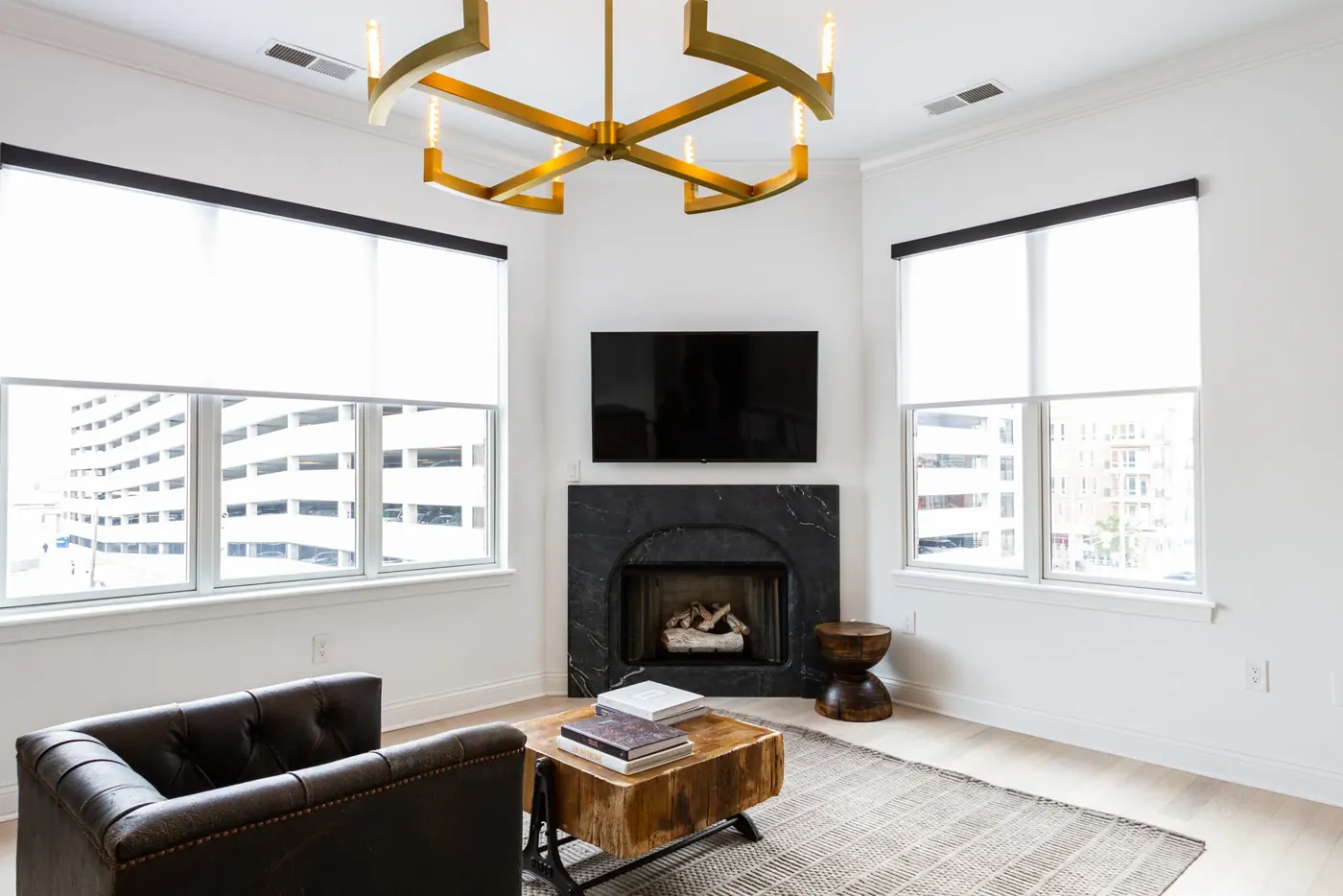
Window Treatment Crews in Garfield Park, Indianapolis, IN
Custom Indianapolis window treatment crews serving Garfield Park homeowners with free in-home measure, repair, replacement.
If you live in this area of Indianapolis, some of these answers will sound familiar. Older openings, shallower depth and out-of-square conditions come up regularly and none of them are a problem once they're measured.
- Services: faux wood blinds, wood blinds, vertical blinds, aluminum mini blinds
- Service area: Garfield Park, Indianapolis, IN and surrounding areas Getting somebody out to measure is the easy part and happens on a normal schedule. After that the fabricator needs roughly two to five weeks. We give you a specific window when we write the order.
- Insured and bonded
- Serving Indianapolis, IN since 2008
Local Window Treatment Experience in Garfield Park
The 1900 to 1925 fabric here is the same fabric that carries a certificate of appropriateness obligation in Irvington five miles northeast: Craftsman bungalows, American Foursquares, Dutch Colonial Revivals, Tudor Revival and Victorian cottages. Garfield Park has none of the obligation. The commission's map layer returns no feature carrying Garfield, so none of the twelve historic districts and none of the five conservation districts is here. Interior blinds, shades and shutters are outside review, and so are exterior awnings and exterior solar shades, because there's no local district over the houses at all. Only the park is listed, and only as part of a boulevard system.</p><p style="font-size:16px;color:#4a5a6a;line-height:1.75;margin:16px 0 0">The other thing that separates this neighborhood from a similar looking one is the park edge itself. Houses on the east side of Shelby Street and along the Garfield Drives look west across 128 acres of open ground with nothing between the glass and the low afternoon sun. That's the hottest residential exposure we deal with in this city, and it runs from about late May through September. Three blocks east, on the same grid and in the same house type, there's a neighbor's roofline in the way and the room behaves completely differently. Two identical bungalows, two different specifications.
We have served Garfield Park homeowners through the full range of window treatment needs, from inspections and repairs to full replacements. Whatever the system, our Indianapolis crew approaches every project with clear communication and respect for your property.
Seventy six years of platting on alley served lots
Garfield named residential platting runs from Holliday's Garfield Park Addition on 5 August 1883 through Bridges & Graves South Garfield Addition on 28 May 1959, ten recorded plats in all. Metzger's came on 20 October 1895, Bohne's on 15 January 1910, St Catherine on 29 December 1910 and Hervey's on 18 February 1911, then Garfield Heights on 9 March 1921, Garfield Plaza on 11 October 1940 and Garfield Terrace on 5 April 1948, with a Garfield Park Apartments Subdivision following on 28 April 2017. The timing tracks transport: the first streetcar reached the area in 1895 and most neighborhood streets were laid out in the early 1900s.
The lot pattern is the narrow deep alley served city lot, with houses closely spaced on vertical lots, small front yards and backyard garages reached from the alleys. Housing runs from the 1842 Yoke farmhouse, the oldest surviving fabric, to twentieth century bungalows and duplexes. Doubles and duplexes are common here in a way they aren't in most neighborhoods of this age. The neighborhood peaked at 13,000 residents in 1962 and now holds around 5,227, having lost more than half its population while keeping its houses, through the Madison Avenue Expressway in 1958 and the completion of I-65 in 1975.
Dormer runs, mirrored duplexes and a west facing park
A Craftsman bungalow on the 1910 to 1925 blocks runs roughly 12 to 18 openings, an American Foursquare on the older additions 16 to 24, a Dutch Colonial Revival 14 to 20 and a Victorian cottage 10 to 16. A double or duplex runs 8 to 14 per unit with the two halves mirrored, which means the same product goes in twice at mirrored handing and mirrored roll direction, and getting that wrong is visible from the street. The stock is almost entirely pre-1940 frame and brick with real wood jambs, applied casing and counterweight pockets, and storm panels still on many houses.
Squareness here has a local cause on top of the usual one. The bulk of the housing is 101 to 116 years old and the oldest fabric is 184, and the neighborhood sits at the confluence of Pleasant Run and Bean Creek on alluvial ground that settles differently from the clay under the north side. On top of that, two interstate corridors were driven through and past the neighborhood, the Madison Avenue Expressway in 1958 and I-65 completed in 1975, which is decades of construction vibration alongside natural settlement. Assume out of square, run a diagonal on every opening, and expect the head and the sill to differ.
The gambrel shed dormer
The most awkward condition in this neighborhood. A Dutch Colonial Revival puts a wide run of openings under a single gambrel roof plane at one head height, and the dormer cheek and the roof take the depth an inside mount needs while the wall below the head is short. We check depth at the stop on every dormer opening before quoting, and the run is usually wide enough to want two headrails under one line rather than one.
Mirrored handing on doubles
A double is two units with mirrored plans, so the same opening appears twice in opposite hand. Everything directional gets set unit by unit rather than copied over, because a treatment that rolls and draws the same way in both halves looks wrong from the pavement. Where both halves are being done together we order in one dye lot. Where only one is, we record the specification for later matching.
Banded bungalow groupings and high flankers
Bungalows here bring groupings of two and three units under broad eaves, front gable and shed dormers, and small high openings flanking a chimney breast. The narrow mullions inside a band give a bracket nowhere to land, and the small high flankers are often better left bare than treated, because covering them costs light and buys no privacy.
West across the park
Houses on the east side of Shelby Street and along the Garfield Drives face 128 acres of open ground with no building between the glass and the afternoon sun. Late May through September that's heat and glare together from mid afternoon. Solar fabric handles the glare; an exterior shade or an awning is what handles the heat, and there's no district here to stop you fitting one.
What we specify in Garfield Park
This is the value end of the city and the sensible approach reflects it without treating it as a lesser job. The median sale price is $193,000 with a median household income of $59,248, so the useful advice is where to concentrate a real budget rather than how to spread a large one. That usually means solving the west facing rooms properly, doing the street facing rooms well because they're seen, and specifying durable rather than fashionable through the rest. Nothing needs anybody's approval, which puts the outside the glass options genuinely on the table.
Exterior solar shades on the park facing rooms
For houses looking west across the park, this is the product that changes the room rather than just the glare, because the energy is stopped before it reaches the glass. In Irvington the same product on the same house type would need a certificate of appropriateness. Here it needs nothing. We check porch posts and eave projection at the measure, because a deep porch changes what an exterior mount can do.
Faux wood blinds through the house
The practical default across bungalow and duplex stock. Faux wood slats hold their shape through the humidity swing that runs from late May to late September and reverses through the heating season, tilt for privacy without shutting a small room down, and mount on the face where the dormer runs have no depth. Across 12 to 18 openings they leave budget for the rooms that need something better.
Cellular shades in the bedrooms
Pre-1940 frame houses are felt in January, and cellular fabric does measurable work: DOE and Oak Ridge National Laboratory testing recorded up to 20 percent of heating energy saved and up to 15 percent of total heating and cooling energy against a bare window. In a west facing bedroom, room darkening fabric on an outside mount with a proper overlap also does more for sleep than any inside mounted blackout can.
Cafe height shutters on the front rooms
Small front yards on narrow lots put the sidewalk close to the glass, and a cafe shutter covers the lower portion at eye level while leaving the daylight above. Rail height gets set standing on the pavement rather than at the midpoint of the opening. Composite rather than hardwood, because the humidity here moves real wood every year and these are not all fully conditioned houses.
Streets, landmarks and schools
The neighborhood is bounded by Beecher Street, I-65, Troy Avenue and East Street and Madison Avenue, about four miles from downtown and south of Fountain Square, at the confluence of Pleasant Run and Bean Creek. Shelby Street is the commercial spine and runs north into Fountain Square, and Madison Avenue and I-65 are how residents describe getting downtown. The park is bounded by Raymond Street on the north, South Garfield Drive, East Garfield Drive and Shelby Street on the east, Southern Avenue on the south and the Louisville and Indiana Railroad tracks on the west. Bates-Hendricks lies northwest. Schools are Indianapolis Public Schools by address, with public charter K-8 options and private options including Trinity Christian School and Calvary Christian School.
No association, no committee, no certificate
There's no homeowners association here, no architectural control committee and no certificate of appropriateness requirement. This is a nineteenth and early twentieth century city neighborhood on a public street grid, and a homeowner spending private money faces no design review from anybody. The park's National Register listing of 28 March 2003 covers the 128 acres and the boulevard system it belongs to, not the surrounding residential blocks, and Indiana Landmarks is explicit that listing alone changes nothing where private funds are used. The one place to take care is work on or immediately adjoining the park itself, which is listed public property in a boulevard system, but that's a public property question rather than a homeowner one.
Window Treatment Services in Garfield Park
Every service Indianapolis Window Treatments offers across Indianapolis is available to Garfield Park homeowners.
Faux Wood Blinds in Garfield Park
Wood look, in the rooms wood can't survive
Learn more →Wood Blinds in Garfield Park
For conditioned rooms where the trim is the point
Learn more →Vertical Blinds in Garfield Park
Built for the opening you walk through
Learn more →Aluminum Mini Blinds in Garfield Park
Low cost per opening, specified to be reordered
Learn more →Roller Shades in Garfield Park
One clean plane, and nothing crossing the glass
Learn more →Solar Shades in Garfield Park
Cut the glare, keep the view, pick the number
Learn more →Cellular Shades in Garfield Park
The one product with measured energy data behind it
Learn more →Zebra Shades in Garfield Park
View by day, cover by night, one motion
Learn more →Roman Shades in Garfield Park
Soft treatment for rooms with height to fill
Learn more →Woven Wood Shades in Garfield Park
Natural texture, with the liner question answered first
Learn more →Blackout Shades in Garfield Park
Dark rooms are hardware, not fabric
Learn more →Plantation Shutters in Garfield Park
The frame absorbs what the opening has done
Learn more →Cafe Shutters in Garfield Park
Privacy at eye level, daylight above it
Learn more →Motorized Shades in Garfield Park
Reachable is the reason. Batteries are the cost
Learn more →Custom Drapery in Garfield Park
Yardage sets the price. The fixing decides the outcome
Learn more →Valances & Top Treatments in Garfield Park
The line that makes mismatched windows read as one
Learn more →Exterior Solar Shades in Garfield Park
Stop the heat outside the glass, with the district checked
Learn more →Retractable Awnings in Garfield Park
Shade in July, sun in January, certificate first
Learn more →Commercial Window Treatments in Garfield Park
Code, cycle count and phasing decide this, not fabric
Learn more →Skylight Shades in Garfield Park
Overhead glass, planned from the ground up
Learn more →Sliding Glass Door Blinds in Garfield Park
The stack has to land off the panel you use
Learn more →Panel Track Blinds in Garfield Park
Stack depth and stack side decide this one
Learn more →Sheer Shades in Garfield Park
Diffused light for windows worth looking at
Learn more →Pleated Shades in Garfield Park
Shallowest headrail in the trade, honestly priced
Learn more →Bamboo Shades in Garfield Park
Natural weave, with the liner question answered first
Learn more →Dual Shades in Garfield Park
Two fabrics, one tube, level or nothing
Learn more →Top-Down Bottom-Up Shades in Garfield Park
Daylight above, cover at eye level
Learn more →Cordless Blinds in Garfield Park
No cords, and a spring that's a wear part
Learn more →Hardwood Shutters in Garfield Park
Real wood, in rooms that stay conditioned
Learn more →Composite Shutters in Garfield Park
For damp rooms, with the weight planned for
Learn more →Smart Home Shade Integration in Garfield Park
Protocol first, range second, hub risk disclosed
Learn more →Blind Repair & Restring in Garfield Park
We check the headrail before quoting the labor
Learn more →Shutter Repair in Garfield Park
Matchable or not, established before we schedule
Learn more →Motorization Retrofit in Garfield Park
Not every headrail takes a motor. We check first
Learn more →Outdoor Patio Shades in Garfield Park
Wind decides this. Anchor into structure, not trim
Learn more →Office Window Treatments in Garfield Park
Control height and openness factor, then fabric
Learn more →Healthcare Window Treatments in Garfield Park
Test documentation, cordless throughout, cleanable surface
Learn more →Multifamily Window Treatments in Garfield Park
One written spec per floor plan, dye lots disclosed
Learn more →Indianapolis Area Coverage
Garfield Park is one of several Indianapolis communities we serve. We measure and install across Indianapolis, Marion County, and surrounding areas.
Garfield Park Window Treatment FAQ
Questions we hear most often from Garfield Park homeowners.
Free Assessment in Garfield Park
Schedule a free, no-obligation window covering inspection. We respond promptly to all Garfield Park inquiries.